Year-end Tax Guide 2019
 Yeo & Yeo’s Year-end Tax Guide 2019 provides action items that may help you save tax dollars if you act before year-end.
These are just some of the steps that can be taken to save taxes. Not all actions may apply in your particular situation, but you or a family member can likely benefit from many of them.
A Yeo & Yeo tax professional can help narrow down the specific actions that you can take and tailor a tax plan for your current situation. Please review the guide and contact Yeo & Yeo CPAs at your earliest convenience so that they can help advise you on which tax-saving moves to make.
For other helpful tools, visit our Tax Center.
‘Tis the season when employers often will provide employees with “gifts” of some type. We all know the entity in town that gives all of its employees a turkey for Thanksgiving or Christmas. While this is a wonderful gesture on the part of the employer, is it compensation to the employee?
A general rule of thumb is to assume that all compensation, which includes gifts, to employees is taxable. There are exceptions to that rule, but they are the exceptions and not the general rule.
The main exception to taxable compensation is De Minimus fringe benefits. There is no set dollar threshold on these; above $100 fair value is not de minimus, but just because it is $25 or less does not automatically make it de minimus. The intent is that the value of the benefits is small (per person and at the entity level), the frequency is infrequent, and it would be an administrative burden to track. This means if the entity is tracking the items itself, such as in inventory, it is not an administrative burden and is not de minimus. However, cash or “cash equivalents” (which includes gift cards, gift certificates, etc.) are never de minimus.
This means that the Subway gift card that is given to select winners in the staff meeting each month is taxable to the employee, even if it is only $10, and should be included in their W-2. However, that Thanksgiving turkey, which is a coupon redeemable for a turkey, and only a turkey, with a value of $X or less, is not a cash equivalent. It is in essence personal property (food) and could be de minimus if the employer deems it a small benefit, the frequency is infrequent, and it would be an administrative burden to track. The Subway gift card is used in place of cash; I could use it as part of multiple different transactions and it has a set face amount that I can use. The coupon instead can only be used in one transaction and it has a maximum face amount, but if I choose a small turkey and do not utilize the entire face amount, I lose the rest. If I choose too large of a turkey that is above the face amount, I cannot simply put that face amount towards the turkey; I must pay for the entire turkey. Therefore, that coupon is not a cash equivalent.
The sweatshirt that you get for free upon joining the organization may qualify as a de minimus fringe if it otherwise meets the criteria. The fact the sweatshirt has the company logo on it does not affect the decision, as you can wear a company sweatshirt anywhere, not just at work. You must look at the value of the benefit (typically its cost to the employer), the frequency, and the administrative burden. If instead it was a hazmat suit that can be worn only at work, it would be a working condition fringe and nontaxable.
Employee achievement awards are not taxable to the employee. However, these have a very strict definition.
- First, they are items of tangible personal property and not cash or cash equivalents.
- Second, the award must be for either 1) a length of service or 2) a safety achievement and must be presented as part of a meaningful presentation.
- Also, the nontaxable amount cannot be more than $400 for any employee.
Sometimes nonprofits provide “stipends” to people. If the payment represents compensation for research, teaching, or other services rendered, it is taxable compensation. If it is simply to offset living expenses during training or a research program, not payment for services, the stipend is not taxable.
The general rule of thumb is that all items given to employees are taxable unless they fit into an exception. If you have specific circumstances you would like to discuss, please reach out to your Yeo & Yeo professional.
‘Tis the season when employers often will provide employees with “gifts” of some type. We all know the entity in town that gives all of its employees a turkey for Thanksgiving or Christmas. While this is a wonderful gesture on the part of the employer, is it compensation to the employee?
A general rule of thumb is to assume that all compensation, which includes gifts, to employees is taxable. There are exceptions to that rule, but they are the exceptions and not the general rule.
The main exception to taxable compensation is De Minimus fringe benefits. There is no set dollar threshold on these; above $100 fair value is not de minimus, but just because it is $25 or less does not automatically make it de minimus. The intent is that the value of the benefits is small (per person and at the entity level), the frequency is infrequent, and it would be an administrative burden to track. This means if the entity is tracking the items itself, such as in inventory, it is not an administrative burden and is not de minimus. However, cash or “cash equivalents” (which includes gift cards, gift certificates, etc.) are never de minimus.
This means that the Subway gift card that is given to select winners in the staff meeting each month is taxable to the employee, even if it is only $10, and should be included in their W-2. However, that Thanksgiving turkey, which is a coupon redeemable for a turkey, and only a turkey, with a value of $X or less, is not a cash equivalent. It is in essence personal property (food) and could be de minimus if the employer deems it a small benefit, the frequency is infrequent, and it would be an administrative burden to track. The Subway gift card is used in place of cash; I could use it as part of multiple different transactions and it has a set face amount that I can use. The coupon instead can only be used in one transaction and it has a maximum face amount, but if I choose a small turkey and do not utilize the entire face amount, I lose the rest. If I choose too large of a turkey that is above the face amount, I cannot simply put that face amount towards the turkey; I must pay for the entire turkey. Therefore, that coupon is not a cash equivalent.
The sweatshirt that you get for free upon joining the organization may qualify as a de minimus fringe if it otherwise meets the criteria. The fact the sweatshirt has the company logo on it does not affect the decision, as you can wear a company sweatshirt anywhere, not just at work. You must look at the value of the benefit (typically its cost to the employer), the frequency, and the administrative burden. If instead it was a hazmat suit that can be worn only at work, it would be a working condition fringe and nontaxable.
Employee achievement awards are not taxable to the employee. However, these have a very strict definition.
- First, they are items of tangible personal property and not cash or cash equivalents.
- Second, the award must be for either 1) a length of service or 2) a safety achievement and must be presented as part of a meaningful presentation.
- Also, the nontaxable amount cannot be more than $400 for any employee.
The general rule of thumb is that all items given to employees are taxable unless they fit into an exception. If you have specific circumstances you would like to discuss, please reach out to your Yeo & Yeo professional.
How can you ensure that an appropriate cybersecurity system is established at your municipality and verify that it is functioning effectively? Although you might not know every detail regarding IT security, as a municipal leader, you should understand your infrastructure and know if your policies and procedures are in place and working as intended.
County and municipal networks are a prime target for hackers as they are like a pot of gold at the end of a rainbow. Government entities have massive amounts of data stored on their networks, and a lot of it contains personally identifiable information or other confidential material. Permits, utility bills, birth certificates, social security numbers and property tax information are just some of the information that is common at local government offices.
Properly implemented security controls can reduce the risk of human error, but not eliminate it. Humans remain the weakest link in any organization when it comes to municipal security risk. Cybercriminals are smart and they know who to target. Hackers target municipalities as they typically have limited budgets to invest in cybersecurity and often have not set aside the necessary resources to train their employees on this very topic. Most security breaches occur because of an internal mistake. A perfect example is that a small Florida city paid hackers almost $600,000 to get its computer systems back, all stemming from an employee who opened a corrupt email.
Below are four key factors to determine how prepared you are.
Security risk assessment – the first step is to understand where the gaps are in your security and recognize vulnerability. This applies to systems, vendors and processes as well as people.
Common weak points: Wi-fi access, hardware, software, and network equipment.
Security updates – one way to significantly improve your fight against attacks is to stay current with security updates. This should be done routinely and as soon as security patches are released.
Common weak points: These patches and updates need to be done on all devices and software. It takes only one missed patch on a device for the hacker to get in and compromise the government’s entire network, just like it only takes one “unlocked door” for a thief to enter your house.
Routine backups – One way to ensure you will not encounter data loss is to create regular backups and store them off-site. This is one of the cheapest and easiest ways to be prepared in the case of a ransomware attack or even a fire.
Common weak points: Backups should be done routinely and stored at a secure off-site location. The backups should be encrypted and tested often. This is necessary to verify that the information can be restored. Often backups are being done but never tested.
Education and Training – One of the biggest risks of cybersecurity attacks in any organization are its own employees. Cybercriminals are great at sending phishing emails that are specifically designed to get employees to click on a malicious link or release sensitive information. These types of emails look legitimate and are hard to detect.
Common weak points: Most organizations focus their cybersecurity initiatives on external threats; they should also address the internal threats, which would be their employees. The most significant benefit would be to train the employees on these threats.
One of the best ways to combat cybersecurity is effective training and testing. Educating the employees on the types of threats to watch for is crucial in protecting your municipality from cybercriminals. This training should include such items as risks related to downloading attachments from unknown emails, identifying phishing scams, ransomware, and malware. Sharing passwords, using networks that are not secure, and flash drives are other risks that should be included in security awareness training. This training should be ongoing, and constant testing has proven to keep employees on their toes as well as identify where additional training and education may be needed.
Please contact Yeo & Yeo Technology at (989) 797-4075 for information about protection for your email infrastructure, a Cybersecurity Assessment for your organization, and Security Awareness Training for the staff — train your employees to be human firewalls, preventing attacks to your organization.
How can you ensure that an appropriate cybersecurity system is established at your organization and verify that it is functioning effectively? Although you might not know every detail regarding IT security, as a business manager, you should understand your infrastructure and know if your policies and procedures are in place and working as intended.
Your organization is a target for hackers, especially if you have massive amounts of data stored on your networks, and if a lot of it contains personally identifiable information or other confidential material.
Properly implemented security controls can reduce the risk of human error, but not eliminate it. Humans remain the weakest link in any organization when it comes to security risk. Most security breaches occur because of an internal mistake. Often, we read reports of organizations that had to pay hackers hundreds of thousands of dollars to get their computer systems back, all stemming from an employee who opened a corrupt email.
Below are four key factors to determine how prepared you are.
Security risk assessment – the first step is to understand where the gaps are in your security and recognize vulnerability. This applies to systems, vendors and processes as well as people.
Common weak points: Wi-fi access, hardware, software, and network equipment.
Security updates – one way to significantly improve your fight against attacks is to stay current with security updates. This should be done routinely and as soon as security patches are released.
Common weak points: These patches and updates need to be done on all devices and software. It takes only one missed patch on a device for the hacker to get in and compromise the government’s entire network, just like it only takes one “unlocked door” for a thief to enter your house.
Routine backups – One way to ensure you will not encounter data loss is to create regular backups and store them off-site. This is one of the cheapest and easiest ways to be prepared in the case of a ransomware attack or even a fire.
Common weak points: Backups should be done routinely and stored at a secure off-site location. The backups should be encrypted and tested often. This is necessary to verify that the information can be restored. Often backups are being done but never tested.
Education and Training – One of the biggest risks of cybersecurity attacks in any organization are its own employees. Cybercriminals are great at sending phishing emails that are specifically designed to get employees to click on a malicious link or release sensitive information. These types of emails look legitimate and are hard to detect.
Common weak points: Most organizations focus their cybersecurity initiatives on external threats; they should also address the internal threats, which would be their employees. The most significant benefit would be to train the employees on these threats.
One of the best ways to combat cybersecurity is effective training and testing. Educating the employees on the types of threats to watch for is crucial in protecting your organization from cybercriminals. This training should include such items as risks related to downloading attachments from unknown emails, identifying phishing scams, ransomware, and malware. Sharing passwords, using networks that are not secure, and flash drives are other risks that should be included in security awareness training. This training should be ongoing, and constant testing has proven to keep employees on their toes as well as identify where additional training and education may be needed.
Please contact Yeo & Yeo Technology at (989) 797-4075 for information about protection for your email infrastructure, a Cybersecurity Assessment for your organization, and Security Awareness Training for the staff — train your employees to be human firewalls, preventing attacks to your organization.
The number of eligible participants at the beginning of the year will determine if your organization’s employee benefit plan requires an audit. An eligible participant is an employee who has met the qualification criteria outlined in the plan document. The employee does not have to be actively participating in the plan to be included in the participant count, rather just eligible to participate.
Employee benefit plans with fewer than 100 eligible participants at the beginning of the year meet the conditions for an audit waiver under 29 CFR 2520.104-46. However, what if your plan has more than 100 eligible participants? Generally, when a plan has more than 100 eligible participants, an audit is required; however, there are exceptions to this rule. If your plan is in its first year of inception, and there are more than 100 eligible participants, then an audit is required. However, if your plan has been in existence for at least one year and this is the first year that it exceeds 100 eligible participants, then an audit may not be required under the 80/120 rule. This rule can be complicated and is best explained by an example:
At the beginning of 2018, an employee benefit plan had 95 eligible participants; thus, an audit was not required for 2018. At the beginning of 2019, eligible participants increased to 110. Under the 80/120 rule, the plan can file as a small plan and is not subject to the audit requirement. Had the eligible participant count gone over 120, then an audit would have been required.
Rather than waiting until next year, review your eligible participant count now. If you think you need an audit, contact Yeo & Yeo today.
A month after the new year begins, your business may be required to comply with rules to report amounts paid to independent contractors, vendors and others. You may have to send 1099-MISC forms to those whom you pay nonemployee compensation, as well as file copies with the IRS. This task can be time consuming and there are penalties for not complying, so it’s a good idea to begin gathering information early to help ensure smooth filing.
Deadline
There are many types of 1099 forms. For example, 1099-INT is sent out to report interest income and 1099-B is used to report broker transactions and barter exchanges. Employers must provide a Form 1099-MISC for nonemployee compensation by January 31, 2020, to each noncorporate service provider who was paid at least $600 for services during 2019. (1099-MISC forms generally don’t have to be provided to corporate service providers, although there are exceptions.)
A copy of each Form 1099-MISC with payments listed in box 7 must also be filed with the IRS by January 31. “Copy A” is filed with the IRS and “Copy B” is sent to each recipient.
There are no longer any extensions for filing Form 1099-MISC late and there are penalties for late filers. The returns will be considered timely filed if postmarked on or before the due date.
A few years ago, the deadlines for some of these forms were later. But the earlier January 31 deadline for 1099-MISC was put in place to give the IRS more time to spot errors on tax returns. In addition, it makes it easier for the IRS to verify the legitimacy of returns and properly issue refunds to taxpayers who are eligible to receive them.
Gathering information
Hopefully, you’ve collected W-9 forms from independent contractors to whom you paid $600 or more this year. The information on W-9s can be used to help compile the information you need to send 1099-MISC forms to recipients and file them with the IRS. Here’s a link to the Form W-9 if you need to request contractors and vendors to fill it out: https://bit.ly/2NQvJ5O.
Form changes coming next year
In addition to payments to independent contractors and vendors, 1099-MISC forms are used to report other types of payments. As described above, Form 1099-MISC is filed to report nonemployment compensation (NEC) in box 7. There may be separate deadlines that report compensation in other boxes on the form. In other words, you may have to file some 1099-MISC forms earlier than others. But in 2020, the IRS will be requiring “Form 1099-NEC” to end confusion and complications for taxpayers. This new form will be used to report 2020 nonemployee compensation by February 1, 2021.
Help with compliance
But for nonemployee compensation for 2019, your business will still use Form 1099-MISC. If you have questions about your reporting requirements, contact us.
© 2019
Four companies. One site. Infinite solutions. Yeo & Yeo CPAs & Business Consultants, Yeo & Yeo Technology, Yeo & Yeo Medical Billing & Consulting, and Yeo & Yeo Wealth Management now have one unified website. The new Yeo & Yeo website brings together all the resources, expertise and solutions that our four companies offer to help you reach your business goals.
The website offers a unique collaboration among your trusted advisors in accounting, audit, tax, technology, wealth management and practice management. It brings all our capabilities together in one location, allowing you to find what you’re looking for easily. Learn about the solutions we provide, meet our advisors, explore our robust Resource Center and access client tools.
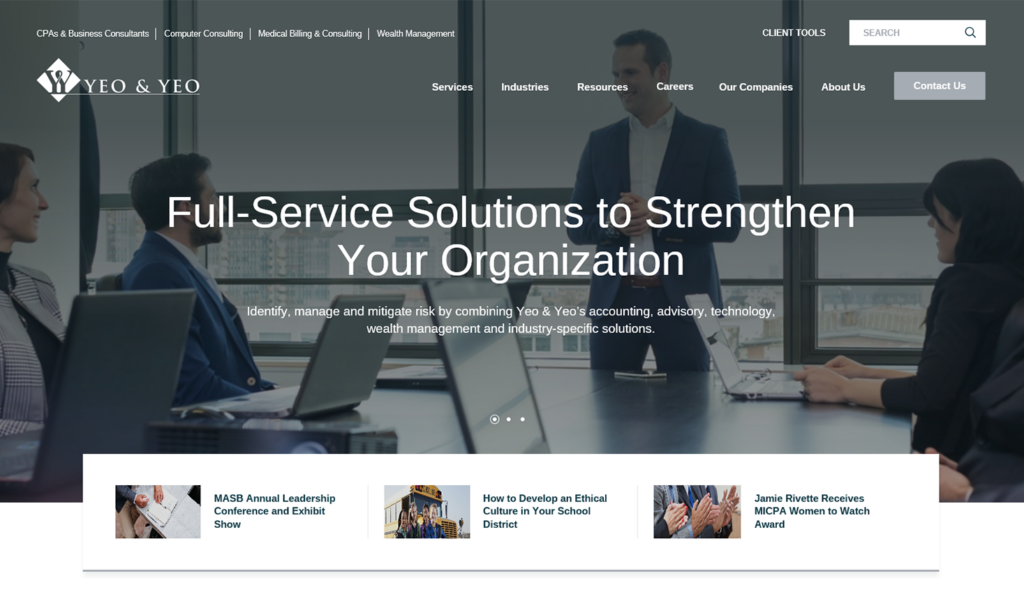
Resource Center. Our blog, eBooks, webinars and more to help answer your questions, solve business problems and keep you informed – from accounting, audit and financial topics to technology and medical billing updates – it’s all centrally organized and easy to find.
Client Tools. Login to your client portal, submit IT service requests, and make secure online payments.
Accessibility. Easily find all the solutions that our companies can provide for Michigan businesses. Need outsourced accounting solutions? Want to know how technology can boost your business’ efficiency? Looking for financial planning advice? Find the answers you are looking for, all in one place.
Never miss a beat! Subscribe to our eNewsletters and eAlerts today!
We are excited to welcome you to our new website.
The right entity choice can make a difference in the tax bill you owe for your business. Although S corporations can provide substantial tax advantages over C corporations in some circumstances, there are plenty of potentially expensive tax problems that you should assess before making the decision to convert from a C corporation to an S corporation.
Here’s a quick rundown of four issues to consider:
LIFO inventories. C corporations that use last-in, first-out (LIFO) inventories must pay tax on the benefits they derived by using LIFO if they convert to S corporations. The tax can be spread over four years. This cost must be weighed against the potential tax gains from converting to S status.
Built-in gains tax. Although S corporations generally aren’t subject to tax, those that were formerly C corporations are taxed on built-in gains (such as appreciated property) that the C corporation has when the S election becomes effective, if those gains are recognized within five years after the conversion. This is generally unfavorable, although there are situations where the S election still can produce a better tax result despite the built-in gains tax.
Passive income. S corporations that were formerly C corporations are subject to a special tax. That tax kicks in if their passive investment income (including dividends, interest, rents, royalties, and stock sale gains) exceeds 25% of their gross receipts, and the S corporation has accumulated earnings and profits carried over from its C corporation years. If that tax is owed for three consecutive years, the corporation’s election to be an S corporation terminates. You can avoid the tax by distributing the accumulated earnings and profits, which would be taxable to shareholders. Or you might want to avoid the tax by limiting the amount of passive income.
Unused losses. If your C corporation has unused net operating losses, they can’t be used to offset its income as an S corporation and can’t be passed through to shareholders. If the losses can’t be carried back to an earlier C corporation year, it will be necessary to weigh the cost of giving up the losses against the tax savings expected to be generated by the switch to S status.
Additional factors
These are only some of the factors to consider when a business switches from C to S status. For example, shareholder-employees of S corporations can’t get all of the tax-free fringe benefits that are available with a C corporation. And there may be issues for shareholders who have outstanding loans from their qualified plans. These factors have to be taken into account in order to understand the implications of converting from C to S status.
Contact us. We can explain how these factors will affect your company’s situation and come up with strategies to minimize taxes.
© 2019
Our Payroll Solutions Group would like to make you aware of important payroll updates that take effect on January 1, 2020. The changes affect businesses that have employees.
Michigan Minimum Wage Increases
Michigan law requires a gradual increase in minimum wage from $9.25 per hour to $12.05 per hour by January 1, 2030. Increases are based on the schedule below. Also, refer to the Michigan Department of Labor Poster.
The current rate, which took effect on March 29, 2019, is $9.45/hour.
1/1/20: $9.65/hour
1/1/21: $9.87/hour
1/1/22: $10.10/hour
1/1/23: $10.33/hour
1/1/24: $10.56/hour
1/1/25: $10.80/hour
1/1/26: $11.04/hour
1/1/27: $11.29/hour
1/1/28: $11.54/hour
1/1/29: $11.79/hour
1/1/30: $12.05/hour
- No inflationary increases.
- The minimum wage for tipped employees remains tied to 38% of the regular minimum wage rate.*
*Under the law, all tipped employees are guaranteed to make at least the minimum wage. If their tips plus the tipped employee minimum wage does not equal or exceed the regular minimum wage, the employer must pay any shortfall to the employee. Failure to comply results in fines and fees.
FLSA Overtime Exemption Salary Threshold Increase
Following are key changes in the Fair Labor Standards Act pertaining to the salary threshold for overtime exemption:
- Increase the minimum salary threshold that exempts an employee from overtime pay from $23,660 to $35,568 per year, or $684 per week.
- Allow employers to use nondiscretionary bonuses and incentive payments (including commissions) paid at least annually to satisfy up to 10% of the salary threshold.
- Increase the “highly compensated employee” white-collar exemption minimum salary threshold from $100,000 to $107,432 per year.
- Employees who do not meet the minimum salary threshold must be paid overtime for every hour worked over 40 hours in a workweek.
For more information, refer to the U.S. Department of Labor Fact Sheet.
Yeo & Yeo CPAs & Business Consultants is pleased to announce the promotions of Elizabeth Gunnell to Project Manager and Melissa (Dean) Lindsey, PCM®, to Practice Growth Manager.
Gunnell has five years of experience in business project management. She will drive strategic initiatives to advance the goals of the firm and its affiliates by leading teams, overseeing research and providing analysis. Gunnell graduated from the University of Michigan with a Bachelor of Arts in Political Science and Psychology. She is a member of the University of Michigan’s Alumni Association and the Association for Accounting Marketing and is active in the LEA Global Marketing and Business Development special interest groups.
Lindsey has more than ten years of marketing, business development, client service and consulting experience. She will help drive the firm’s growth strategy, provide executive coaching for the firm’s senior employees, and manage lead generation marketing initiatives. Lindsey holds a Bachelor of Arts from Saginaw Valley State University and studied public relations and crisis communication at Vesalius College in Brussels, Belgium. Additionally, she earned the Professional Certified Marketer (PCM®) designation through the American Marketing Association. She is a member of Thomson Reuters’ Checkpoint Marketing for Firms Advisory Board, the Association for Accounting Marketing, the Social Media Club of the Great Lakes Bay Region and the LinkedIn Advisors Community. She is active in the LEA Global Marketing and Business Development special interest groups.
Together Gunnell and Lindsey will further the growth of the firm’s niche and service practice areas.“ Elizabeth and Melissa’s combination of project management, business development and marketing experience will enhance our client service culture,” says Thomas Hollerback, President & CEO. “We have experienced growth in many of our practice areas and they will play a key part in continuing our success by providing our professionals with the strategic direction and resources they need to align Yeo & Yeo’s solutions with their clients’ goals and objectives.”
Gunnell and Lindsey will work cross-functionally with firm leadership and the firm’s three affiliates – Yeo & Yeo Technology, Yeo & Yeo Medical Billing & Consulting, and Yeo & Yeo Wealth Management – across Yeo & Yeo’s nine offices statewide.
As expected, the Financial Accounting Standards Board (FASB) announced that the new lease accounting standard will be delayed for one year for non-public companies. This will give private companies, nonprofits and small companies in particular more time to prepare.
The amendments to the Leases Standard (ASU No. 2016-02, Leases – Topic 842)
amend the effective dates as follows:
- Nonpublic entities (FASB definition) – first annual reporting period beginning after December 15, 2020. This affects 12/31/2021 year-ends.
- Nonpublic entities (FASB definition) – first interim reporting period beginning after December 15, 2021. This affects 1/31/2022 month-ends.
For more information, please contact your Yeo & Yeo advisor or read this article about the FASB vote in the Journal of Accountancy.
Is your business depreciating over a 30-year period the entire cost of constructing the building that houses your operation? If so, you should consider a cost segregation study. It may allow you to accelerate depreciation deductions on certain items, thereby reducing taxes and boosting cash flow. And under current law, the potential benefits of a cost segregation study are now even greater than they were a few years ago due to enhancements to certain depreciation-related tax breaks.
Depreciation basics
Business buildings generally have a 39-year depreciation period (27.5 years for residential rental properties). Most times, you depreciate a building’s structural components, including walls, windows, HVAC systems, elevators, plumbing and wiring, along with the building. Personal property — such as equipment, machinery, furniture and fixtures — is eligible for accelerated depreciation, usually over five or seven years. And land improvements, such as fences, outdoor lighting and parking lots, are depreciable over 15 years.
Often, businesses allocate all or most of their buildings’ acquisition or construction costs to real property, overlooking opportunities to allocate costs to shorter-lived personal property or land improvements. In some cases — computers or furniture, for example — the distinction between real and personal property is obvious. But the line between the two is frequently less clear. Items that appear to be “part of a building” may in fact be personal property, like removable wall and floor coverings, removable partitions, awnings and canopies, window treatments, signs and decorative lighting.
In addition, certain items that otherwise would be treated as real property may qualify as personal property if they serve more of a business function than a structural purpose. This includes reinforced flooring to support heavy manufacturing equipment, electrical or plumbing installations required to operate specialized equipment, or dedicated cooling systems for data processing rooms.
Identifying and substantiating costs
A cost segregation study combines accounting and engineering techniques to identify building costs that are properly allocable to tangible personal property rather than real property. Although the relative costs and benefits of a cost segregation study depend on your particular facts and circumstances, it can be a valuable investment.
Speedier depreciation tax breaks
The Tax Cuts and Jobs Act (TCJA) enhances certain depreciation-related tax breaks, which may also enhance the benefits of a cost segregation study. Among other things, the act permanently increased limits on Section 179 expensing, which allows you to immediately deduct the entire cost of qualifying equipment or other fixed assets up to specified thresholds.
The TCJA also expanded 15-year-property treatment to apply to qualified improvement property. Previously this break was limited to qualified leasehold-improvement, retail-improvement and restaurant property. And it temporarily increased first-year bonus depreciation to 100% (from 50%).
Making favorable depreciation changes
Fortunately, it isn’t too late to get the benefit of speedier depreciation for items that were incorrectly assumed to be part of your building for depreciation purposes. You don’t have to amend your past returns (or meet a deadline for claiming tax refunds) to claim the depreciation that you could have already claimed. Instead, you can claim that depreciation by following procedures, in connection with the next tax return that you file, that will result in “automatic” IRS consent to a change in your accounting for depreciation.
Cost segregation studies can yield substantial benefits, but they’re not right for every business. We must judge whether a study will result in overall tax savings greater than the costs of the study itself. To find out whether this would be worthwhile for you, contact us.
Ann Arbor
Located in southeast Michigan, Ann Arbor is a thriving city with an abundance of opportunities to explore. NICHE magazine ranked Ann Arbor as one of the “Best Cities to Live in America” citing that the city offers a suburban feel that has been dubbed an urban oasis.
Located in a bustling college town near the University of Michigan, Ann Arbor celebrates art, theater, film festivals, athletics, music, academics, history and more. More than 300 restaurants within the Ann Arbor area serve up dishes prepared by world-class chefs. The annual award-winning Ann Arbor Art Fair and the three-week long Ann Arbor Summer Festival enrich the cultural, economic and social vitality of the region. In the fall, more than 100,000 people travel to Ann Arbor each game day to watch the University of Michigan Wolverines compete in “The Big House.” Ann Arbor is one of the biggest cities in Michigan and offers unparalleled opportunities for businesses, cultural experiences and more.
What is it like to have a location in Ann Arbor, MI?
Located in a bustling college town near the University of Michigan, Ann Arbor celebrates art, theater, film festivals, athletics, music, academics, history and more. More than 300 restaurants within the Ann Arbor area serve up dishes prepared by world-class chefs. The annual award-winning Ann Arbor Art Fair and the three-week long Ann Arbor Summer Festival enrich the cultural, economic and social vitality of the region. In the fall, more than 100,000 people travel to Ann Arbor each game day to watch the University of Michigan Wolverines compete in “The Big House.” Ann Arbor is one of the biggest cities in Michigan and offers unparalleled opportunities for businesses, cultural experiences and more.
Yeo & Yeo’s Ann Arbor Services
Yeo & Yeo is among the leading advisory firms in the nation, and among the top 10 CPA firms in Michigan. Clients rely on our integrated solutions in areas including accounting, audit, tax, valuation, technology, and wealth management. Ann Arbor’s major industries are education and healthcare, which employ nearly 50% of Ann Arbor’s working population. We have developed specialized practices in these industries and many more that are key to the economic makeup of Ann Arbor and its surrounding areas.
For more information on working and living in Ann Arbor, visit the Ann Arbor/Ypsilanti Chamber of Commerce website.
Troy
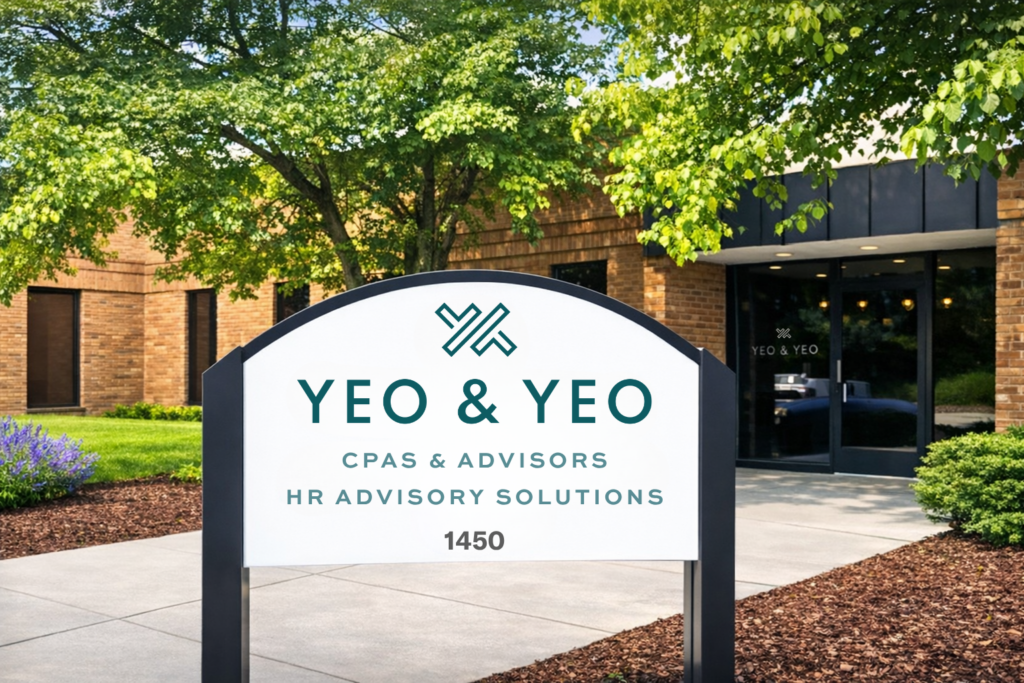
Yeo & Yeo’s Auburn Hills and Bloomfield Hills offices have relocated to Troy. Located in Southeast Michigan, Troy is a hub for business and innovation, just a short drive from downtown Detroit. Known for its thriving automotive, manufacturing, and financial sectors, Troy offers a unique blend of economic opportunity, cultural richness, and community spirit.
What is it like to have a location in Troy, MI?
Troy is home to Walsh College and the Somerset Collection, one of Michigan’s premier shopping destinations. The Troy Historic Village brings history to life with immersive exhibits that showcase the area’s 19th-century roots and 20th-century growth. Conveniently located north of Detroit, Troy offers residents and businesses easy access to the cultural and economic heart of the region, making it an ideal place to live and work.
Yeo & Yeo’s Troy Services
Troy is home to Walsh College and the Somerset Collection, one of Michigan’s premier shopping destinations. The Troy Historic Village brings history to life with immersive exhibits that showcase the area’s 19th-century roots and 20th-century growth. Conveniently located north of Detroit, Troy offers residents and businesses easy access to the cultural and economic heart of the region, making it an ideal place to live and work.

Flint
In the 1900s, Flint was an automotive powerhouse, home to the General Motors headquarters. Today, downtown Flint boasts classic brick streets and scenic architecture mingled with modern ideas and diverse populations that flourish on the campus of the University of Michigan-Flint.
What is it like to have a location in Flint, MI?
Flint is located in Genesee County, home of Michigan’s largest county park system with more than 11,000 acres of woods, water and trails. The Flint Cultural Center provides a unique educational and entertainment resource with its group of nationally-recognized cultural institutions, including the Flint Institute of Arts, The Whiting and the Longway Planetarium. Flint annually celebrates its automotive history with Back to the Bricks, a car show that attracts more than 500,000 enthusiasts. The abundance of educational and cultural resources make Flint bright with possibilities.
Yeo & Yeo’s Flint Services
Yeo & Yeo is among the leading advisory firms in the nation. Clients rely on our integrated solutions in areas including accounting, tax, audit, valuation, technology, medical billing and wealth management. Flint’s major industries are healthcare, education and manufacturing, which employ over 35% of Flint’s working population. We are proud to serve these industries and many more in our Flint office.
For more information on working and living in Flint, visit the Flint & Genesee Group website.

Kalamazoo
Located in southwest Michigan, about two hours from Chicago, Kalamazoo is a progressive city with endless opportunities.
What is it like to have a location in Kalamazoo, MI?
Kalamazoo is known for quality dining, unique shops, galleries, live entertainment and more. Home to Michigan’s oldest microbrewery, Kalamazoo is one of the top beer destinations in the world. Residents and visitors can explore Kalamazoo’s Smithsonian-affiliated aerospace education center, the Air Zoo, with over 60 rare and unique aircraft and spacecraft. The city also has an extensive amount of street art that can be viewed in the Kalamazoo Wall Crawl. Kalamazoo blends energy, innovation and friendliness to bring big-city experiences with a small-town feel.
Yeo & Yeo’s Kalamazoo Services
Yeo & Yeo is among the leading advisory firms in the nation, and among the top 10 CPA firms in Michigan. Our clients rely on our forward-thinking solutions in areas including accounting, audit, tax, valuation, technology, medical billing and wealth management. Education, healthcare and manufacturing are among Kalamazoo’s three largest industries, employing over 40% of Kalamazoo’s working population. We are proud to serve these industries and many more in our Kalamazoo office.
For more information on working and living in Kalamazoo, visit the Southwest Michigan First website.
Lansing
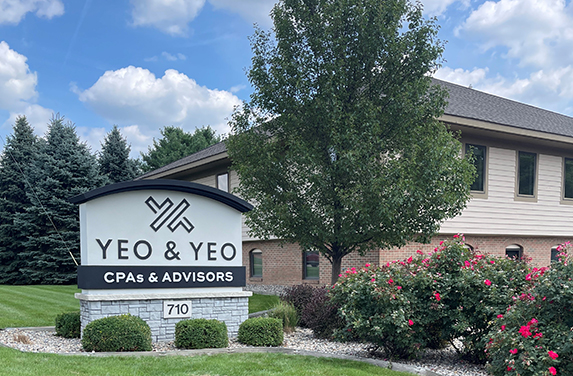
Lansing, the capital city of Michigan, is home to more than 1,000 businesses, including galleries, retail stores, restaurants, law firms, lobbyists and other professional offices. As the spearhead for Michigan’s state government, the city is a center for activity with endless entertainment and opportunities to explore.
Address
2843 Eyde ParkwaySuite 230
East Lansing, Michigan 48823
Phone
Fax
517.323.8360 Get DirectionsWhat is it like to have a location in Lansing, MI?
Lansing is a hub for education, business, high-tech manufacturing, three medical schools, two law schools, an international airport, museums and performing arts centers. The city is home to Michigan State University, which boasts a nationally recognized museum, Big Ten athletic events and one of the nation’s largest cafeterias. The Lansing Lugnuts, the region’s Class A professional baseball team, play games at Cooley Law Stadium. Lansing is a one-of-a-kind setting with the bustle of a capital city and the hospitality of a small town.
Yeo & Yeo’s Lansing Services
Yeo & Yeo is among the leading advisory firms in the nation, and among the top 10 CPA firms in Michigan. Our clients value our forward-thinking solutions in areas including accounting, audit, tax, technology, medical billing and wealth management. Lansing’s major industries are healthcare and manufacturing, with public administration and government being one of the highest paying industries in the area. We are proud to serve these industries and many more in our Lansing office.
For more information on working and living in Lansing, visit the Lansing Regional Chamber of Commerce website.

Midland
Located in the heart of Michigan, Yeo & Yeo’s Midland office provides a variety of integrated solutions in accounting, assurance, tax, technology, medical billing and wealth management. Midland is located in the Great Lakes Bay Region, only a short drive from Lake Huron’s Saginaw Bay. As home to the Fortune 500 Company Dow Chemical, Midland has become a hub for research, development and business growth.
What is it like to have a location in Midland, MI?
The City of Midland has been recognized as a great place to raise a family, find and keep a job, participate in recreational activities and more. Midland is home to the largest tree canopy walk in the United States, located in the Whiting Forest of Dow Gardens with Dow Gardens itself boasting 110 acres of botanical beauty. Midland’s Chippewa Nature Center contains 19 miles of scenic trails that span over 1,200 acres. The Dow Diamond stadium is home to Midland’s Class A minor league baseball team, the Great Lakes Loons. With an abundance of nature and growing business opportunities, Midland is a great community to live and work in.
Yeo & Yeo’s Midland Services
Yeo & Yeo is among the leading accounting and advisory firms in the nation. Clients rely on our integrated solutions in areas including accounting, tax, audit, valuation, technology, medical billing and wealth management. Midland’s major industries are manufacturing and healthcare, which employ nearly 40% of Midland’s working population. We are proud to serve these industries and many more in our Midland office. Managing Partner of Yeo & Yeo’s Midland office, John Haag, CPA/ABV, CVA, CFF specializes in business valuation and litigation support services, preparation of corporate income tax returns and financial statements, business consulting and succession planning.
For more information on working and living in Midland, visit the Midland Business Alliance website.

Southgate
Southgate is a city at the “Heart of Downriver.” With a convenient location just nine miles outside of Detroit, Southgate is minutes from a booming business center with world-class cultural attractions.
Yeo & Yeo’s Southgate Services
Yeo & Yeo is among the leading advisory firms in the nation, and among the top 10 Michigan CPA firms. Our clients rely on our integrated solutions in areas including accounting, audit, tax, valuation, technology, medical billing and wealth management. Southgate’s major industries are manufacturing and healthcare, with manufacturing being one of the highest paying industries in the area. We have developed specialized practices in these industries and more that are key to the economic makeup of Southgate and its surrounding region.
For more information on working and living in Southgate, visit the Southern Wayne County Regional Chamber website.