Interview with Kati Krueger
In celebration of our many women leaders who have been instrumental in Yeo & Yeo’s success, we are proud to feature one of our remarkable leaders, Kati Krueger, CMPE.
For years, we have provided our professionals with a healthy work-life balance, supporting them in their efforts to effectively balance a growing career and fulfilling home life. Our total workforce is over 54% female, and those in leadership positions exceed 50%. We are incredibly proud of our family-friendly culture and our ability to attract and retain women.
This is Kati’s perspective on her career, leadership, and the importance of self-confidence.
Q: Tell me about your career and your role at Yeo & Yeo Medical Billing & Consulting.
I began as a co-op student with Yeo & Yeo Medical Billing & Consulting (formerly Affiliated Medical Billing) in 2002. After graduating from Saginaw Valley State University, I advanced to Marketing Assistant, Marketing Manager, Billing Manager, and then vice president. In 2017, the company changed its name to Yeo & Yeo Medical Billing & Consulting, and I took the reins as president. As president, I lead the strategic initiatives for YYMBC, working with my staff to provide medical billing, consulting, and practice management to organizations throughout Michigan and beyond.
Q: What do you enjoy most about your career?
Medical Billing is an industry that is constantly changing and keeping us on our toes. I enjoy the challenge of learning new rules and regulations and being able to help teach our staff about those changes so they can be successful with their jobs. I also find it very rewarding to watch staff grow and become talented medical billers and coders.
Q: When you began your career, did you ever imagine that you would have a leadership role?
I have been blessed to be with Yeo & Yeo Medical Billing & Consulting for over 20 years. I started as a high school co-op student, and I can honestly say I did not think this is where I would end up. I am grateful for the opportunity and the path I was able to take at Yeo & Yeo. The firm’s leaders helped guide me to where I am today.
Q: What was the best advice you ever received?
Be confident in the information you are presenting. Many times when giving a presentation or meeting with a potential client, you will be questioned about the knowledge you are providing. You must remember you are the expert in that field, and you must stay confident in what you know is accurate information.
Q: What advice would you give to the next generation of female leaders?
Don’t compare yourself to others. We all have different talents and lead in different ways. That’s what makes us unique. When we start comparing ourselves to others, it limits our own creativity and potential.
Q: Why is empathy in the workplace so important?
Empathy helps us connect with our staff and build relationships. When we have a better understanding of our staff by building those relationships, it allows us to be better leaders as it creates trust, communication, and respect within our team.
As of April 10th, 2023, the Biden Administration has announced that the end of the Public Health Emergency (PHE) Covid-19 will be on May 11th ,2023. Included in the end of the PHE, the Department of Health and Human Services (HHS) Office of Civil Rights (OCR) has stated that the Notifications of HIPAA Enforcement Discretion will also end on My 11th, 2023. Previously, the Administration guaranteed a 90-day warning for providers to come into compliance to HIPAA rules relating to telehealth services. This 90-day grace period is meant to help avoid “creat[ing] wide-ranging chaos and uncertainty throughout the health care system — for states, for hospitals and doctors’ offices, and, most importantly, for tens of millions of Americans,” (HHS Press Office). OCR said it would continue to exercise its enforcement discretion and not impose penalties on covered providers for noncompliance during the 90- day transition period, ending on August 9th,2023.
During the public health emergency, providers did not have to be licensed in the state where the patient was located, they were allowed to treat patients in other states via telecommunication. Under the PHE, non-HIPAA compliant platforms were allowed if they were not public facing. Both flexibilities are coming to an end.
In 2020, when the PHE was first declared, the federal government changed or halted many of its rules and regulations on how care is delivered. During the PHE, rules were relaxed regarding staff training in nursing home facilities. There was also easier virtual access to prescribe medications pertinent in treatment relating to addiction.
In hospitals, the broader use of nurse practitioners and physician assistants was implemented to ensure there were enough healthcare workers to treat patients. Another hospital exception that will be terminated once the PHE ends is “CMS allowing hospitals to make broader use of nurse practitioners and physician assistants when caring for Medicare patients. New physicians not yet credentialed to work at a particular hospital — for example, because governing bodies lacked time to conduct their reviews — could nonetheless practice there,” (Pradhan, Rachana – CBS News). Regarding monitoring the disease, because the Department of Health and Human Services will no longer be able to require labs to report Covid-19 testing data, the way local and state public health departments monitor the spread of disease will change. It is expected that while at-home test kits will no longer be free, and hospitals will most likely provide Covid-19 data less frequently, that surveillance will need to be strategized.
Sources
“From Addiction Treatment to Nursing Homes, End of COVID Emergency Will Bring Changes across U.S.
Health Care System.” CBS News, CBS Interactive, https://www.cbsnews.com/news/covid-public
health-emergency-impact-hospitals-addiction-treatment-nursing-homes/.
Morse, S. (n.d.). Providers granted 90 days following end of phe to comply with HIPAA Telehealth Rules. Healthcare
Finance News. Retrieved April 17, 2023, from https://www.healthcarefinancenews.com/news/providers
granted-90-days-following-end-phe-comply-hipaa-telehealth
rules#:~:text=The%20Office%20of%20Civil%20Rights,Health%20and%20Human%20Services%20OCR.
(OCR), Office for Civil Rights. “HHS Office for Civil Rights Announces the Expiration of COVID-19 Public Health
Emergency HIPAA Notifications of Enforcement Discretion.” HHS.gov, 11 Apr. 2023,
https://www.hhs.gov/about/news/2023/04/11/hhs-office-for-civil-rights-announces-expiration-covid-19
public-health-emergency-hipaa-notifications-enforcement
discretion.html?mkt_tok=MTQ0LUFNSi02MzkAAAGLGX8tEWzg_owkte8B
voTgAz5e8NZFXHeT2ZNUj2hj38TVJy-9oAeDOyF7gM3xSRl_qyap6MztJK9sIwPx53UBkcaBbTB1v
H_b6QH9MsPA.
Watson, Kathryn. “Biden Signs Bills to Reverse D.C. Criminal Code Changes and Declassify Info on Covid
19 Origins.” CBS News, CBS Interactive, 20 Mar. 2023, https://www.cbsnews.com/news/biden-dc-crime-bill-covid-19-origins/.
On November 1st, the Centers for Medicare and Medicaid Services (CMS) released their final Medicare Physician Fee Schedule (PFS). This new and final 2023 ruling affects not only Medicare payout to physicians, but the Merit-based Incentive Payment System (MIPS), and the alternative payment model (APM) as well.
“Anesthesia Conversion Factor, work Relative Value Units (RVUs) for several pain medicine codes, and policy updates for the 2023 QPP performance year will be effective January 1, 2023. Absent Congressional action, all physician practices – including anesthesiologists and their groups – will face significant Medicare payments cuts next year,” (American Society of Anesthesiologists). Anesthesia being the most affected, with a 4.47% decrease from the rates in the current year of 2022. This decrease may seem small, but it will make a big impact as the year goes on.
With this finalized ruling, we will also see extended telehealth provisions that was put in place due to the public health emergency. Once the PHE is declared as finished, to ensure a smooth transition, they have chosen to extend the provisions by 151 days – “including allowing payment for RHCs and FQHCs for furnishing telehealth services as distant site practitioners (though note that mental health visits can be furnished virtually on a permanent basis) under the payment methodology established for the PHE, allowing telehealth services to be furnished in any geographic area and in any originating site setting, including the beneficiary’s home, and allowing certain services to be furnished via audio-only telecommunications systems,” (CMS.gov).
“MGMA submitted detailed comments in response to the proposed rule in September. Be on the lookout for a more detailed analysis of the final changes to physician payment policies and the Quality Payment Program (QPP) in the coming weeks,” (MGMA Regulatory Alert).
For more information, and to keep up to date on policy changes, please follow the following links or sources:
Sources:
“Fact Sheet Calendar Year (CY) 2023 Medicare Physician Fee Schedule Final Rule.” CMS, https://www.cms.gov/newsroom/fact-sheets/calendar-year-cy-2023-medicare-physician-fee-schedule-final-rule?utm_source=email&utm_medium=marketo&utm_campaign=gov-washingtonconnection-oct-2022-regalert1031&mkt_tok=MTQ0LUFNSi02MzkAAAGH1B6DQSAYQZNXcZCy3E_z53VOq5t7ZbNvsM5maFQZnsPwXfV3TSCRCRJOnFGeC08dWNFDKMtCP8mJhXaa8C_S9kuhEONhijo_bV39AX_9cQ.
“CMS Provides Little Relief for Anesthesia Groups in Release of 2023 Payment Rules.” American Society of Anesthesiologists (ASA), https://www.asahq.org/advocacy-and-asapac/fda-and-washington-alerts/washington-alerts/2022/11/cms-provides-little-relief-for-anesthesia-groups-in-release-of-2023-payment-rules#:~:text=CMS%20has%20finalized%20significant%20cuts,2022%20anesthesia%20CF%20of%20%2421.5623.
My husband is in the Reserves, and he served overseas in 2004. From that experience, I know how much our troops appreciate care packages and mail, which is why I began volunteering with Aaron’s Gifts From Home more than three years ago.
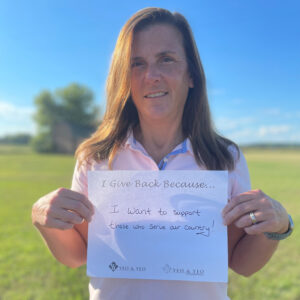 Aaron’s Gifts was founded in 2012 by the parents of Aaron Ullom, a service member in the Navy who was killed in action in Afghanistan. In honor of Aaron’s memory, the organization sends care packages to soldiers stationed overseas. The packages include comic books, DVDs, snacks and games – anything a service member might enjoy.
Roughly three times a year, a group of us get together to pack hundreds of boxes for active-duty service members. I am proud that I have the opportunity to give back to those serving our country and protecting our freedoms. Aaron’s Gifts is truly a great organization, and I am so appreciative that I get to be part of it.
I give back because I want to support those who serve our country.
A vote is expected to be made soon within the Senate regarding the extension of COVID-19 temporary waivers; The House of Representatives voted 416-12 to pass the “Advancing Telehealth Beyond COVID-19 Act.” This legislation would continue Medicare patient access to telehealth services, including audio-only services. This extension, if passed within the Senate, will extend temporary waivers that have been put in place due to the PHE all the way through December 31, 2024. Below is a list of continuing waivers from Karen Zupko & Associates Inc.:
- Continuing the pause on geographic restrictions limiting the patient’s location to a metropolitan statistical area (MSA) or a rural health professional shortage area (HPSA) (some exceptions). The patient’s home is still an acceptable location.
- Allowing the expanded list of eligible providers (i.e., PT, OT, SLP, and audiologists) to continue to provide telehealth services on the Medicare approved list within their scope of practice.
- Continuing coverage for non-mental health audio-only visits.
- Continue allowing FQHCs and RHCs to be distant site telehealth providers for non-mental health visits.
- Delaying certain mental health visit requirements for in-person visits.
- Allowing telehealth to satisfy face-to-face encounters before hospice care recertifications.
Sources:
kpage_drupal. “House-Passed Bill Would Extend Medicare Telehealth Flexibilities : AHA News.”
American Hospital Association | AHA News, https://www.aha.org/news/headline/2022-07-28
house-passed-bill-would-extend-medicare-telehealth
flexibilities#:~:text=The%20House%20yesterday%20voted%20416,COVID%2D19%20public%20
ealth%20emergency.
“KZA Telehealth Solutions Center.” KZA Telehealth Solution Center – Access Page,
https://karenzupko.com/KZA-telehealth-solution-center-access.
During the COVID-19 pandemic, the Centers for Medicare & Medicaid Services (CMS) enacted several temporary emergency declaration blanket waivers. The waivers were intended to provide health care providers with extra flexibility.
On April 7, 2022, CMS issued memorandum QSO-22-15 that will end many of the blanket waivers for specific providers in 30 and 60 days from publication of the memo.
Of note, one waiver that will end provides the capacity for physicians and practitioners to conduct visits via telehealth options. Effective May 7, 2022, visits to nursing home residents must be performed in person.
Providers are expected to take immediate steps so that they may return to compliance with the reinstated requirements.
Please contact Yeo & Yeo if you have questions or need assistance.
The Health Resources & Services Administration (HRSA) announced an opportunity for providers to submit a Request to Report Late Due to Extenuating Circumstances for PRF Reporting Period 1 if one or more of the extenuating circumstances described below apply.
Providers will be able to submit a Request to Report Late Due to Extenuating Circumstances for Reporting Period 1 from Monday, April 11 to Friday, April 22, 2022, at 11:59 p.m. ET.
HRSA explains that the only providers who meet one or more of the identified extenuating circumstances will be eligible to submit a Late Reporting Request for Reporting Period 1. These circumstances include:
- Severe illness or death of a provider or key staff member responsible for reporting
- Impacted by a natural disaster
- An incorrect email or mailing address on file with HRSA prevented the organization from receiving instructions prior to the Reporting Period deadline
- The provider registered, completed their report but forgot to click the “submit” button before the deadline
- An internal miscommunication or error about who was authorized and expected to report on behalf of the organization and/or the registered point of contact
- An incomplete targeted distribution report where the parent organization completed all General Distribution payment reports but a targeted distribution was not reported on by the subsidiary
The provider must indicate and attest to a clear and concise explanation of the applicable extenuating circumstance; however, supporting documentation will not be required.
If HRSA approves the request, the organization will receive a notification to proceed with completing the Reporting Period 1 report. Providers will have ten days from the date they receive the notification to submit a report in the PRF Reporting Portal. There will be no extensions to this timeline, so providers should prepare their documentation as soon as possible and be ready to file once notified that they are approved. Providers can review the PRF Reporting Portal User’s Guide to help them determine what information will be required.
Providers who plan to submit a Request to Report Late Due to Extenuating Circumstances, but have not registered in the PRF Reporting Portal, should complete registration prior to submitting their request. Registration instructions are on the PRF Reporting webpage.
Note that providers will also have an opportunity to submit a Request to Report Late Due to Extenuating Circumstances for Reporting Period 2 if the extenuating circumstances are applicable. Providers will receive a notification regarding the process to submit a request for RP2 in the coming weeks.
As of March 22nd, 2022, the HRSA (Health Resources and Services Administration) will no longer reimburse healthcare providers for claims submitted for COVID-19 testing and treatments of uninsured patients. Starting April 5th, 2022, they will stop accepting claims for vaccinations against COVID-19 as well. However, according to the CDC, COVID-19 Vaccination Program Providers must continue to administer COVID-19 vaccines at no out-of-pocket cost to recipients. This Uninsured Program was provided during the COVID-19 pandemic to provide healthcare providers reimbursement for Covid testing, treatments, and administering vaccinations. These reimbursements typically came within 30 days and were generally Medicare rates.
Any claims submitted for testing and treatments after March 22nd will not be reviewed for reimbursement, and after April 5th, claims for vaccinations will not be reviewed. This decision was made due to lack of sufficient funds. Claims that were submitted before the deadlines will be put into review and reimbursed according to availability of funds. The HRSA anticipates that claims submitted by the deadline may take longer than the typical 30 business day timeframe to process to determine the availability of funds. There are other resources are available to providers and/or uninsured individuals after the deadlines have passed. Alternative resources for uninsured individuals who need COVID-19 services or need assistance with other medical expenses and procedures are listed below:
- Medicaid enrollment
- Healthcare marketplace enrollment
- gov
- gov – Find a Health Center
For more information, please visit https://www.hrsa.gov/
On March 15, 2022, President Biden signed a $1.5 trillion spending package into law, extending telehealth services relating to the PHE. Summed up below are the waivers that will be in effect for another 151 days after the PHE Covid-19 has concluded (April 16th, 2022):
- “Originating site and geographic location” – Patients can continue to be treated via telehealth communication anywhere
- “Qualifying providers” – Furnishing distant site telehealth services can be provided by physical therapists, occupational therapists, speech language pathologists, and audiologists
- “Audio-only services” – These services must continue to be covered and reimbursed by CMS
- “Federally Qualified Health Centers (FQHCs) and Rural Health Clinics (RHCs)” – Can be distant sites and can be reimbursed
- This also delays in-person visitation requirements for mental telehealth visits for 152 days after the conclusion of the PHE
For more information about the mental telehealth expansions, see MGMA’s 2022 final Physician Fee Schedule analysis.
Yeo & Yeo is pleased to announce that Kati Krueger, CMPE, President of Yeo & Yeo Medical Billing & Consulting, was recognized as one of ten recipients of the 2021 RUBY Awards presented by 1st State Bank.
Krueger was honored among the area’s brightest professionals under the age of 40 who have made their mark in their professions and are having an impact throughout the Great Lakes Bay Region.
“This award recognizes Kati’s leadership and her commitment to continuous improvement for the benefit of our clients,” said Dave Youngstrom, Yeo & Yeo’s President & CEO. “She is disciplined, dedicated and highly respected by her staff. She has a passion for building up those around her, and she is a great ambassador for Yeo & Yeo in the community and the associations she is affiliated with.”
 Krueger began as a co-op student with Yeo & Yeo Medical Billing & Consulting (formerly Affiliated Medical Billing) in 2002. After graduating from Saginaw Valley State University, she advanced to Marketing Assistant, Marketing Manager, Billing Manager, and then a year as vice president. In 2017, the company changed its name to Yeo & Yeo Medical Billing & Consulting, and she took the reins as president.
Under Krueger’s leadership, the company has undergone significant transformation in its operations, recognizing greater efficiencies for staff and clients. Krueger has led several significant technology advancements within the billing company, most recently implementing bots to further streamline workflows and processes. Clients look to her as a resource for solving the operational and financial challenges of running a successful medical practice.
“I am honored to be recognized alongside so many of our community leaders,” Krueger said. “I am incredibly proud of my entire team who help support our company and our clients. I couldn’t have achieved this without all of you.”
Krueger’s expertise lies in serving the firm’s healthcare clients in all aspects of medical billing, coding and practice management, and serving as a highly effective leader for Yeo & Yeo Medical Billing & Consulting’s staff. She is a strong mentor, and her experience in marketing and business development has led the team toward solid growth.
Krueger is a member of the Medical Group Management Association, the Michigan Medical Group Management Association and the Health Care Compliance Association. In the community, she serves as a volunteer at Nouvel Catholic Central Elementary School.
Amid the global COVID-19 pandemic, the federal tally shows that a record number of major health data breaches were reported in the U.S. in 2021. The overwhelming majority of them involved hacking/IT incidents.
As of January 17, the Department of Health and Human Services’ HIPAA Breach Reporting Tool website shows 713 major health data breaches affecting more than 45.7 million individuals posted for 2021.
4 Common Date Breaches
- Hacking/IT incidents were the most dominant type of health data breach. Hacking/IT incidents were involved in 73% of all 2021 breaches posted to the HHS website so far, but those incidents were responsible for about 94% of individuals affected.
- Some 147 “unauthorized access/disclosure” breaches affected more than 2.2 million individuals in 2021. That’s about 20% of total breaches and about 4.8% of those individuals involved in 2021.
- Only 16 loss/theft breaches involving unencrypted computing devices – such as laptops and mobile storage gear – were posted to the HHS website in 2021. Those incidents, which were the primary source of significant health data breaches in years past, affected fewer than 100,000 individuals in 2021.
- Business associates were reported as being involved in 251 breaches affecting 21.3 million individuals in 2021. That means vendors and other business associates handling protected health information were involved in about 35% of major HIPAA breaches in 2021. Those business associate incidents affected about 46% of all individuals affected by major health data breaches last year.
Driving Forces Behind Cyberattacks
“Breaches will increase as businesses continue to automate more. Data is the new currency in the cyber world,” says Tom Walsh, founder of privacy and security consultancy tw-Security.
But that is not just a healthcare sector problem, some professionals note. “I assume the number of breaches across industries has risen. [This] goes along with the worldwide nature of cyber business and security and crime. And the pandemic exacerbates it all,” says Kate Borten, president of privacy and security consultancy The Marblehead Group.
Hacking incidents, in particular, will continue to plague the healthcare sector, Walsh says. “Hackers have stepped up their efforts. With new tools available, it’s even easier for someone with basic experience to launch a more sophisticated attack,” he says.
Walsh says hackers had to be technically skilled in operating systems and software to launch an attack successfully. But now, software-as-a-service tools and tools using artificial intelligence are making it easier for novice hackers.
Source: https://www.govinfosecurity.com/record-number-major-health-data-breaches-in-2021-a-18327
Medicare was scheduled to set large physician cuts in motion at the beginning of 2022. As of December 9th, 2021, Congress has passed legislation that prevents those cuts from taking place. This legislation lessens the severity of the -3.75% impact that Medicare was planning to make by 3%. This mitigation expressed by Congress has to do with the previously delayed 2021 budget neutrality adjustments that were set to affect the physician fee schedule in 2022.
This legislation invalidates the required 4% pay-as-you-go sequester that was a result of the American Rescue Plan Act for 2022, as well as delaying reinstatement of Medicare’s current 2% sequester until March of 2022. Plans are to phase in a 1% sequester through June of 2022. “Sequestration is the automatic reduction (i.e., cancellation) of certain federal spending, generally by a uniform percentage. The sequester is a budget enforcement tool that was established by Congress in the Balanced Budget and Emergency Deficit Control Act of 1985 (BBEDCA, also known as the Gramm-Rudman-Hollings Act; P.L. 99-177, as amended) and was intended to encourage compromise and action, rather than actually being implemented (also known as triggered). Generally, this budget enforcement tool has been incorporated into laws to either discourage or encourage certain budget objectives or goals. When these goals are not met, either through the enactment of a law or the lack thereof, a sequester is triggered and certain federal spending is reduced,” (Congressional Research Service, 2021).
Further delays have been brought into motion due to this legislation being passed; cuts to physician office laboratories and the next round of data reporting are only just a few. Congress has expressed their gratitude for the thousands of letters sent by MGMA members that prevented Medicare from subjecting physician offices to payment reductions. They are still calling upon Congress to reform current policies that allow such things (such as the Medicare sequester) to take place unless a movement is made by MGMA, Congress, etc.
Sources:
Medicare and Budget Sequestration. https://sgp.fas.org/crs/misc/R45106.pdf
“Medical Group Management Association.” MGMA, https://www.mgma.com/
Unexpectedly, the United States Department of Health and Human Services has reopened the Provider Relief Fund portal as of December 13th at 9:00 AM ET. This grants more time to those providers and offices that did not get a chance to complete and submit of reports for the first reporting period. The portal will be open for submissions from December 13th 2021 to December 20th 2021 at 11:59 PM ET.
Medical practices and providers that have already submitted a report for the first reporting period can access their report if there are errors that need to be corrected. Please contact the provider support line at (866) 569-3522 to be granted access to your submission. Take into account that the second reporting period will begin at the first of the new year on January 1st, 2022.
To access the portal, please follow the link above or visit https://prfreporting.hrsa.gov/
Starting January 1st 2022, changes within Medicare’s physician fee schedule will take effect. These changes that were issued on November 2nd, 2021, will update policies for Medicare payments. “The calendar year (CY) 2022 PFS final rule is one of several rules that reflect a broader Administration-wide strategy to create a health care system that results in better accessibility, quality, affordability, empowerment, and innovation,” (CMS, 2021).
Previously, for a majority of services that were performed in the office setting, Medicare made their payments on a single rate based on the resources involved in performing the service. Starting in 2022, CMS released a series of proposals that include standard rate-setting refinements. With these changes starting January 1st 2022, CMS is authorizing Medicare to make direct payments to physician assistants for services they perform under Medicare part B. As it stands right now, Medicare can only make payments to the employer or independent contractor. “The 2022 Physician Fee Schedule proposed regulatory changes would align policies with the Federal statute of the Consolidated Appropriations Act of 2021 [section 403]. The act amends the Social Security Act and removes the requirement that payment for services performed by PAs be made to their employer and allow payment to be made directly to a PA,” (DePalma).
Along with the changes to the PA PFS, these proposals “revise telehealth services under the Consolidated Appropriations Act, 2021, which allows use of audio-only communications technology when furnishing mental health services in certain circumstances. It also finalizes recent changes to Evaluation and Management (E/M) visit codes, such as policies for split (or shared) E/M visits, critical care services, and services furnished by teaching physicians. Modifications are also being made to payments for therapy services furnished in whole or in part by a Physical Therapist Assistant or Occupational Therapy Assistant. Updates to payment regulation for Medical Nutrition Therapy services are similarly being added as well as finalization for vaccine administration services,” (CMS, 2021).
Please follow this link for the original article pertaining to the above information.
Sources:
“Fact Sheet Calendar Year (CY) 2022 Medicare Physician Fee Schedule Final Rule.” CMS,
https://www.cms.gov/newsroom/fact-sheets/calendar-year-cy-2022-medicare-physician-fee
“Physician Fee Schedule.” CMS, https://www.cms.gov/Medicare/Medicare-Fee-for-Service
Payment/PhysicianFeeSched.
“Physician Assistants Will Benefit with Direct Pay under CMS Proposed Rule.” Healio,
https://www.healio.com/news/nephrology/20210812/physician-assistants-will-benefit-with
direct-pay-under-cms-proposed-rule.
The Department of Health and Human Services has extended the PHE (public health emergency) for Covid-19; this newest order went in to effect on October 18, 2021. For another 90 days, all “telehealth waivers and other flexibilities pursuant to the PHE determination” will continue. This pushes the most current PHE declaration to end on January 16, 2022. Indicated by the Biden Administration, they intend to give the healthcare community 60 days’ notice before allowing the PHE to lapse in order to give them time for preparation. You can view the full renewal here.
This renewal will be the 8th order revolving around Covid-19 nationally. The initial order titled “Determination that a Public Health Emergency Exists Nationwide as the Result of the 2019 Novel Coronavirus,” was put into effect on January 31, 2020. On April 21, 2020, this PHE was extended, and is also when this disease got its name that we know it as now “Coronavirus; Covid-19.” According to the CDC, “an outbreak is called an epidemic when there is a sudden increase in cases. As COVID-19 began spreading in Wuhan, China, it became an epidemic. Because the disease then spread across several countries and affected a large number of people, it was classified as a pandemic.”
Sources:
https://www.phe.gov/emergency/news/healthactions/phe/Pages/default.aspx
https://www.phe.gov/emergency/news/healthactions/phe/Pages/COVDI-15Oct21.aspx
A new surprise billing rule that “establishes dispute resolution process for patients, providers, and plans,” was released recently in September of this year. The Department of Health and Human Services released an addition to the rules that outlines the “No Surprises Act.” The No Surprises Act “prohibits balance billing in the case of surprise medical bills — those for non-emergency services furnished by out-of-network providers during a visit by the patient at an in-network facility — unless the law’s notice and consent requirements are met,” (National Law Review, Cummings). This act was first introduced as a part of the Consolidated Appropriations Act, which was enacted in December of 2020.
“A surprise bill is an unexpected bill from a health care provider or facility. This can happen when a person with health insurance unknowingly gets medical care from a provider, facility, or provider of air ambulance services outside their health plan’s network. Surprise billing happens in both emergency and non-emergency care settings,” (CMS, 2021). In an emergency, the patient will be treated by the facility nearest them; this can result in care being performed by those not in-network with the patient’s insurance. In non-emergency cases, patients may have chosen a facility and/or physician that is in-network with their insurance, however, someone behind the scenes of their care, for example a radiologist or an anesthesiologist, may not be in-network. This can cause an outstanding bill for the patient that they were not expecting, which is where this No Surprises Act comes into play.
This new rule continues to protect patients against surprise medical bills by following through with out-of-pocket limits, and requiring patient consent before performing any medical procedures or examinations. Along with following previous procedures and ideals for this rule, MDHHS has included a new process and guidelines for independent dispute resolution (IDR). This allows patients to dispute a surprise medical bill when the care provided was not discussed and approved beforehand. Patients will also be granted good faith estimates for uninsured (or self-pay) individuals. Patient-provider dispute resolution processes are outlined in this new rule, allowing patients to discuss these matters directly with their medical provider with expanded rights to external review. The process that agencies will use to evaluate the IDR disputes are outlined as well. IDR will be implemented starting at the first of the year in 2022. The Federal Register released the second interim final rule on their website.
Please visit the new CMS Surprise Billing Page for all of the latest updates. “The Departments and OPM intend to post additional information over the next several months, including information about how to initiate an independent dispute resolution process in the federal portal, and plan to highlight different provisions as they become more relevant to different stakeholders and audiences,” (CMS, 2021).
Sources:
Article Updated September 30, 2021
Starting September 29, 2021, health care providers will be able to apply for $25.5 billion in relief funds that includes $8.5 billion in American Rescue Plan (ARP) resources for providers who serve rural Medicaid, Children’s Health Insurance Program (CHIP), or Medicare patients. Additionally, $17 billion is available for Provider Relief Fund (PRF) Phase 4 for a broad range of providers who can document revenue loss and changes in expenses associated with the pandemic.
Those providers that can provide documentation of significant losses due to the pandemic from July 1, 2020, to March 31, 2021, may be eligible for funding. The providers’ most recent tax documents and financial statements for the second half of calendar year (CY) 2020 and the first quarter of CY 2021, may be used as supporting documentation.
The application will be open for four weeks. Providers must submit their completed application by the deadline of October 26 at 11:59 p.m. ET.
- Eligibility requirements, application instructions and links, technical webinars and other helpful resources are available on the Health Resources and Services Administration (HRSA) website here: https://www.hrsa.gov/provider-relief/future-payments
To ensure equity and to support healthcare providers with the most need, HRSA will reimburse a higher percentage for those providers that are considered smaller than others. They will also provide extra payments to providers based on the amount of services rendered to Medicaid, CHIP, and Medicare patients.
For those providers that render services to those patients that live in Federal Office of Rural Health Policy-defined rural areas, $8.5 billion will be distributed based on the number of services provided. Price payments will be at the higher Medicare rates for Medicaid and CHIP patients.
- Review what areas qualify providers for this potential funding here: https://data.hrsa.gov/tools/rural-health?tab=Address
Sources:
“Future Payments.” Official Web Site of the U.S. Health Resources & Services Administration, 10 Sept. 2021, www.hrsa.gov/provider-relief/future-payments.
“Rural Health Grants Eligibility Analyzer.” Rural Health Grants Eligibility Analyzer, data.hrsa.gov/tools/rural-health?tab=Address.
“Provider Relief Fund Reporting Requirements and Auditing.” Official Web Site of the U.S. Health Resources & Services Administration, 10 Sept. 2021, www.hrsa.gov/provider-relief/reporting-auditing.
“The Centers for Medicare & Medicaid Services has established code pairs that identify procedure codes that are either mutually exclusive or incidental to one another, or that shouldn’t be reported together due to an overlap in services. [They] currently use the National Correct Coding Initiative, or NCCI, list as published by CMS,” (BCBS, 2021). When in line with Medicare Plus Blue claims, BCBS will begin editing claims that have a 59-modifier attached. The list from NCCI establishes whether or not a 59-modifier can be applied to allow two opposing codes to be billed together and accepted. Along with changes for Medicare Plus Blue claims, changes surrounding the 59-modifier will impact Medicare Advantage PPO claims as well. These changes will promote appropriate use of this modifier to prevent any inaccuracy when billing. Modifier 59 is used when services are performed on the same day that aren’t normally reported together. This code separates the two services as two billable codes. Please see the attached articles for more information and specific scenarios, as well as guidelines to follow when billing in the future.
Sources:
“Claim Editing Update for Modifier 59 Coming Later This Year to MEDICARE PLUS Blue Claims.” The
Record,www.bcbsm.com/content/dam/microsites/corpcomm/provider/the_record/2021/sep/ ecord_0921v.shtml.
“Claim Editing Update Coming This Year to Medicare Advantage Ppo Claims with Modifier 59.” The
Record,www.bcbsm.com/content/dam/microsites/corpcomm/provider/the_record/2021/aug/
ecord_0821r.shtml.
“Starting in November 2021, Blue Cross Blue Shield of Michigan will begin working with Optum, a data, analytics and consulting group, for enhanced prospective claim editing for services provided to our commercial members. We anticipate that this change will help promote correct coding and support payment accuracy,” (BCBS, 2021). In a recent article from BCBS, they explained to surgical providers that coding will need to be changed starting in November of 2021. However, it is highly recommended to start this process sooner, rather than later. In addition to normal CPT codes for surgical procedures, there will need to be an anatomical code attached to let insurance companies know the part of the body in which the surgery was performed.
BCBS will begin performing enhanced prepayment claim reviews; these reviews will help monitor the usage of codes and if they are being overutilized – in addition, they will prevent unnecessary costs. As a result of these reviews, providers may be asked to provide medical records to back these codes. When asked to submit medical records, there will be complete instructions on each request letter as to how to do that. Forewarning, there is limited allotted time to get the medical records submitted, otherwise providers will see denials on their claims until Optum gets the requested information.
Please follow the links below for more information, and to know which CPT code range needs these enhancements.
Sources:
“Claim Editing Enhancements Coming to Blue CROSS Commercial Claims.” The Record, www.bcbsm.com/content/dam/microsites/corpcomm/provider/the_record/2021/sep/Record_0921w.shtml.
“Optum to Provide ENHANCED Prospective CLAIM Editing for Blue CROSS Commercial Claims.” The Record, www.bcbsm.com/content/dam/microsites/corpcomm/provider/the_record/2021/aug/Record_0821q.shtml.
The Covid-19 National Public Health Emergency has been extended as of July 19th, 2021 to October 17th, 2021; this will affect the temporary provisions that have already been in place for testing and patient visits that are Covid related. The temporary provisions were expected to be just that, temporary. The PHE was scheduled to end July 19th, however, due to the new Delta variant of the virus, new precautions have been put into effect and the emergency has been extended.
Continuing from February of 2020, United Healthcare will continue to waive cost-sharing for in and out-of-network Covid-19 testing and Covid related patient visits, including telehealth visits and antibody testing. This does not include routine or surveillance testing (i.e. testing in order to return to the workplace, travel, or entertainment purposes). Cost -sharing only applies to tests that are physician, or licensed health care professional, ordered and administered. Covid-19 testing that has been purchased over the counter that will not have been ordered or administered by a healthcare professional will not be covered by the member’s insurance plan, however, the patient may choose to use their health savings account (HSA). If an over the counter test has been ordered, the patient may submit a claim for reimbursement. Some services that are outside of the Covid-19 scope can continue to be done through telehealth, however, there are no cost-sharing waivers in effect at this time and will continue to be the member’s responsibility. Please reference the links below for more information on what services still fall under the umbrella of cost-sharing waivers.
During the Public Health Emergency, United Healthcare will not require a referral for an emergency for those with a Medicare Advantage plan, as well as others. Again, please follow your states specific guidelines as they may vary from state-to-state. In regards to credentialing and recredentialing, “these are consistent with National Council on Quality Assurance (NCQA) standards, as well as any specific state and federal regulations for participation in Medicare and Medicaid programs. Some states may have additional requirements as part of the credentialing and recredentialing process,” (United Healthcare Services, Inc.). Any radiology services that are performed related to potential Covid-19 exposure or symptoms does not require prior-authorization, but providers are asked to submit particular CPT codes when billing. Please reference the Covid-19 Temporary Provisions link for more information, specifically page 6, 12, 13, and 18.
Please refer to your states specific Covid-19 website or hotline for more information on Medicaid variations state-by-state.
For more information, please follow the links below.
Covid-19 Information and Resources | Covid-19 Temporary Provisions
Sources:
“Covid-19 Information and Resources.” UnitedHealthcare Provider, United Healthcare Services, Inc., 19 July 2021, www.uhcprovider.com/en/resource-library/news/Novel-Coronavirus-COVID-19.html.
“Covid-19 Temporary Provisions.” Uhcprovider.com, United Healthcare Services, Inc., 19 July 2021, www.uhcprovider.com/content/dam/provider/docs/public/resources/news/2020/covid19/COVID-19-Date-Provision-Guide.pdf?cid=em-providernews-PCA12102634-jul21.