Coordinating Scholarships and 529 Plans
For 18 years, you have carefully saved for your child’s education using a 529 plan, accumulating a sizable sum, but your child has earned a scholarship or two—so now what? First of all, congratulations, both you and your child have much to celebrate! But now what should you do with the extra 529 funds to minimize penalties and tax?
First, note that section 529 funds can be used for more than just tuition and fees—other expenditures qualify too. This includes textbooks, internet expense, a computer and any software used primarily for education. And then there is the big one, room and board for your student if attending at least half time.
Not living on campus? No problem! Colleges and universities annually publish a “cost of attendance” calculation for each school year, which details the approximate amount of room and board. You may make tax-free distributions from a 529 plan up to this amount for a student not living on campus. For students actually living on campus, if this price exceeds the quote in the cost of attendance, the actual amount spent may be distributed.
Still going to have funds left? There are a few other options. First, if there is another child you would like to name as the beneficiary, the accounts may be transferred between siblings, or even to a spouse or first cousin, but make sure that the beneficiary has changed before making distributions for the newly appointed student, or this can cause you tax headaches down the road.
If there is no other potential beneficiary, any excess amounts up to the amount of scholarships earned may be withdrawn without penalty; however, any earnings on the withdrawal would be subject to tax. See the following example:
Sam has a scholarship that pays for all tuition annually, which is expected to be $10,000. Sam’s parents have saved diligently and, even after making withdrawals for room and board, they are expecting to have $40,000 left over in the account, as it was the amount anticipated for tuition ($10,000 x 4 Years = $40,000).
In year one, $10,000 above the amount for room board and other expenses is withdrawn. The 10% penalty does not apply, as Sam has scholarships of $10,000, which is what caused the overfunding in the 529 plan. At the time of withdrawal, 60% of the account is contributions, 40% is earnings. As the beneficiary of the account, Sam will pay income tax on the $4,000 in earnings that are withdrawn.
In year two, $11,000 (55% contributions, 45% earnings) above the amount for room and board and other expenses is withdrawn. Sam incurs $10,000 in tuition and fees, all of which is covered by a scholarship. In this case, the earnings portion of $1,000 ($1,000 x 45%=$450) of the $11,000 is subject to a 10% penalty for being a distribution in excess of the amount of scholarship covered expenses, which in this case would be $45 ($450 x 10%). $4,950 ($11,000 x 45%), the amount of earnings from the distribution, is also subject to income tax.
Fortunately, students are often in a lower tax bracket, which lessens the tax sting somewhat. If you will make 529 plan distributions, check with your tax professional to set the best course to minimize the tax implications of distributions, along with maximizing any educational credits for which you may qualify.
The recent announcement that procurement requirements related to Uniform Guidance have once again been delayed is not cause to return the issue to the back burner. The implementation date is scheduled for July 1, 2018. This extension should be utilized as a trial period to work out the problems instead of a procrastination period to create more. This article provides a summary of the procurement section of the 2 CFR 200 to make the changes seem a little easier to tackle.
As a refresher, the principles related to Uniform Guidance were developed to help unify, clarify, simplify, and standardize the numerous federal grant requirements previously in play. The new guidance provided 80 fewer pages than the combined circulars it replaced in the hopes of eliminating duplicative or conflicting guidance. The document focuses on leveraging technology, minimizing waste, fraud and abuse, and shifting the focus from compliance to performance. The document still boasts a whopping 140+ pages of information related to federal grant compliance; however, the general tone is one of outcomes.
In addition to focusing on outcomes, the 2 CFR 200 moved internal control guidance into administrative requirements with the purpose of enforcing stronger underlying systems before federal expenditures are incurred. In the past, this section was only included in the audit requirements, which resulted in noncompliance only after the funds were spent. This focus is one of the underlying reasons for the procurement changes that organizations should implement to satisfy the new requirements by the July 1st deadline.
Although 140+ pages may seem like an overwhelming place to start, the 2 CFR 200 is a relatively simple read. The following summary is intended to help lay the groundwork for procurement changes, but a knowledge of the actual requirements will greater ensure your organization’s compliance.
General procurement requirements start at §200.318 of the Uniform Guidance. One of the first items to note is that every entity must have its own documented procurement procedures. In the past, various organizations provided example documents that could be leveraged, but ultimately the procurement procedures must be specific to your organization. It cannot be a generic document.
General procurement also states that procedures should identify if insubstantial financial interests or nominal value gifts are acceptable. If this is not explicitly written into a procurement procedure manual, the default is that none are allowed. Also, general procurement states that procedures must avoid acquisition of duplicative or unnecessary items. This section further encourages inter-entity agreements when appropriate to extend the reach of resources, and also encourages that lease versus purchase analysis are performed as necessary. Also, the new guidance requires written conflict of interest policies that address the selection, award, and administration of procured vendors. It also requires that violations are met with disciplinary action.
It is important that your procurement procedures address the oversight of contractors to ensure they are performing in accordance with their contract, which should be written to include necessary federal grant requirements. If there is any knowledge that a contractor is not considered responsible and unable to perform successfully, the organization should not award them any federal contracts. Contractor oversight leads into the next section of the procurement requirements that addresses full and open competition.
This section of the 2 CFR 200 (§200.319) specifically states that when contractors are involved in the developing and/or drafting of specifications, requirements, statements of work, and invitations to bid or RFPs, they cannot compete for that procurement. In addition, the procurement procedures should encourage competition by requiring that a clear and accurate description of technical requirements, minimum essential characteristics of the product (detailed product specifications should be avoided, if at all possible), all requirements offerors must fulfill, and the factors to be used in evaluating bids/proposals, be included in every RFP.
To further ensure competition, prequalification lists must be current and include enough qualified sources to ensure open and free competition. Situations considered to be restrictive of open competition include the following:
- Placing unreasonable requirements on firms in order for them to qualify to do business.
- Requiring unnecessary experience and excessive bonding.
- Noncompetitive pricing practices between firms or between affiliated companies.
- Noncompetitive contracts to consultants that are on retainer contracts.
- Organizational conflicts of interest.
- Specifying only a “brand name” product instead of allowing an “equal” product to be offered.
- Any arbitrary action in the procurement process.
- Geographical preferences unless a federal statute is mandated or encouraged
Directly following General Procurement and Competition is the area of the upcoming procurement changes that most organizations will need to address now. This section (§200.320) contains the five allowable procurement methods that must be written into every organization’s procurement policies and utilized as needed. The five procurement methods are:
1)Micro-purchases (new for government): aggregate does not exceed $3,500 ($10,000 for some organizations)
An organization should distribute equitably among qualified suppliers and only need consider the price reasonable.
2)Small purchases: cost less than Simplified Acquisition Threshold ($150,000)
Price or rate quotations from an adequate number of qualified sources (no definition of adequate, but judgment would state more than 1)
3)Sealed bids: if complete specifications, two or more responsible bidders, and procured item lends itself to firm fixed-price contract
Publicly advertise invitation for bids, all bids publicly opened at time and place prescribed in invitation, firm, fixed-price contract awarded to lowest responsive and responsible bidder, sound reasons for rejection must be documented, consideration given to discounts, transportation costs, and life cycle costs.
4)Competitive proposal: if conditions are not appropriate for a sealed bid, there is more than one source, and the procured item lends itself to a fixed-price or cost-reimbursement contract
Requests for proposals must be publicized and identify all evaluation factors and relative importance, solicited from an adequate number of qualified sources, a written method for conducting technical evaluations of proposals and selecting recipients, award to “most advantageous” proposal including price and other factors. Only architectural/engineering can use selection without consideration of cost
5)Noncompetitive proposals (restrictions on usage 100c new for nonprofits): if only available from one source, or if public exigency or emergency that will not permit delay, or if federal awarding agency or pass-through entity expressly authorizes, or after soliciting a number of sources competition is determined inadequate
Solicitation from only one source
It is likely that your organization is already utilizing some or all of the methods above, so the change is not expected to be drastic. The most drastic change is thoroughly documenting the method selected and ensuring procurement procedures are properly updated to include all five of these methods. The form of documenting the method selected can vary as 2 CFR 200 is focused on the ‘what’ not the ‘how.’ Utilizing current software is one recommendation as every vendor disbursement should be run through your accounting system. Making note of a micro or small purchase item in the description or another field of the software may be an efficient way to document the method. Even writing the method on each invoice will do the trick as long as you remember to do so. However you choose to implement, start now. Practice for the upcoming fiscal year, so that when it comes time for your audit after July 1, 2018, you are fully in compliance.
Other items to mention in the 2 CFR 200 procurement section include contract cost and price analysis guidelines at §200.323, as well as suspended and debarred parties. An organization must perform cost or price analysis in connection with every procurement over the Simplified Acquisition Threshold. Cost plus percentage of cost, and percentage of construction cost methods are never allowed in federal procurement. Also, a contract award must not be made to parties listed on the government-wide exclusions in the System for Award Management (SAM). Ensure that there is a system in place to regularly monitor federal vendors with this website at https://www.sam.gov/.
As a reminder, the complete 2 CFR 200 can be found at: https://www.federalregister.gov/articles/2013/12/26/2013-30465/uniform-administrative-requirements-cost-principles-and-audit-requirements-for-federal-awards. Learn more about the implementation of Uniform Guidance.
July 1, 2018 will be here in no time and another extension should not be relied upon. We encourage you to use the additional time and the contents of this article to help you implement procurement changes now, so you will not have to say UGH! to UG procurement later!
Under new accounting rules effective for fiscal years beginning after December 15, 2017, all nonprofits will now be required to show an analysis of expenses by both function and nature. Functional expense allocation can be challenging for nonprofits. Expenses must be divided among various functions, according to the purpose for which the costs are incurred.
- What nuances have changed in the new standard, even for those who have prepared a statement of functional expenses for years?
- What are the differences between the types of functional expense classifications — program services, supporting services, management and general expenses, and expenses incurred for fundraising?
- Which expense allocation method should be used — direct or indirect?
- Does expense allocation change for a federal grant?
Yeo & Yeo is pleased to offer an updated whitepaper, Functional Expense Allocation for Nonprofits after FASB ASU 2016-14, that explains functional classifications and other issues to consider in allocating expenses for your organization under the new accounting rules.
Beyond meeting compliance requirements, there are very good reasons to care about the functional classification of expenses, as they help tell the story of a nonprofit. If you have a question, reach out to Yeo & Yeo’s Nonprofit experienced professionals.
During the past few years, the construction industry has seen a shortfall in the number of skilled tradesmen available for employment. The shortage has caused business owners grief in trying to maintain proper staffing for the jobs that they bid on and perform. There are many reasons for the decline in the availability of qualified workers: the older generation retiring from the workforce, immigration laws that the Trump administration has proposed, and added pressure on millennials to go to a traditional, post-secondary school for education instead of seeking opportunities in the skilled trades.
I recently spoke with a construction client I work closely with, and when I asked how busy he was during this time, he said that he had to turn down some work; much of this was the result of the inability to retain good help. He has tried to incentivize working at his company by offering better wages and more relaxed hours but, in the end, a lot of the workers he has are simply not qualified to perform the work the way he demands. Most applicants he sees do not have proper training in the trade, and therefore would be behind from the start.
Fortunately, construction organizations within Michigan have realized this is a very real problem and have set initiatives to counteract this dilemma. By partnering with and providing funding for local trade schools and construction academies, the number of qualified, skilled tradesmen is on the rise. The curriculums allow the students in the program to explore the many different sectors of the industry – everything from carpentry and electrical, to plumbing and pipefitting. This allows the students to identify which area within the skilled trades best suits their abilities.
The best way for construction business owners to get in front of this new talent is to reach out to local construction academies (for example, Mount Pleasant Vocational/Tech Center or the Greater Michigan Construction Academy in Midland). The academies can put you in contact with the talent that they have.
Donating to charity is more than good business citizenship; it can also save tax. Here are three lesser-known federal income tax breaks for charitable donations by businesses.
1. Food donations
Charitable write-offs for donated food (such as by restaurants and grocery stores) are normally limited to the lower of the taxpayer’s basis in the food (generally cost) or fair market value (FMV), but an enhanced deduction equals the lesser of:
- The food’s basis plus one-half the FMV in excess of basis, or
- Two times the basis.
To qualify, the food must be apparently wholesome at the time it’s donated. Your total charitable write-off for food donations under the enhanced deduction provision can’t exceed:
- 15% of your net income for the year (before considering the enhanced deduction) from all sole proprietorships, S corporations and partnership businesses (including limited liability companies treated as partnerships for tax purposes) from which food donations were made, or
- For a C corporation taxpayer, 15% of taxable income for the year (before considering the enhanced deduction).
2. Qualified conservation contributions
Qualified conservation contributions are charitable donations of real property interests, including remainder interests and easements that restrict the use of real property. For qualified C corporation farming and ranching operations, the maximum write-off for qualified conservation contributions is increased from the normal 10% of adjusted taxable income to 100% of adjusted taxable income.
Qualified conservation contributions in excess of what can be written off in the year of the donation can be carried forward for 15 years.
3. S corporation appreciated property donations
A favorable tax basis rule is available to shareholders of S corporations that make charitable donations of appreciated property. For such donations, each shareholder’s basis in the S corporation stock is reduced by only the shareholder’s pro-rata percentage of the company’s tax basis in the donated asset.
Without this provision, a shareholder’s basis reduction would equal the passed-through write-off for the donation (a larger amount than the shareholder’s pro-rata percentage of the company’s basis in the donated asset). This provision is generally beneficial to shareholders, because it leaves them with higher tax basis in their S corporation shares.
If you believe you may be eligible to claim one or more of these tax breaks, contact us. We can help you determine eligibility, prepare the required documentation and plan for charitable donations in future years.
© 2017
The tax consequences of the sale of an investment, as well as your net return, can be affected by a variety of factors. You’re probably focused on factors such as how much you paid for the investment vs. how much you’re selling it for, whether you held the investment long-term (more than one year) and the tax rate that will apply.
But there are additional details you should pay attention to. If you don’t, the tax consequences of a sale may be different from what you expect. Here are a few details to consider when selling an investment:
Which shares you’re selling. If you bought the same security at different times and prices and want to sell high-tax-basis shares to reduce gain or increase a loss to offset other gains, be sure to specifically identify which block of shares is being sold.
Trade date vs. settlement date. When it gets close to year end, keep in mind that the trade date, not the settlement date, of publicly traded securities determines the year in which you recognize the gain or loss.
Transaction costs. While transaction costs, such as broker fees, aren’t taxes, like taxes they can have a significant impact on your net returns, especially over time, because they also reduce the amount of money you have available to invest.
If you have questions about the potential tax impact of an investment sale you’re considering — or all of the details you should keep in mind to minimize it — please contact us.
© 2017
What if you need to see the profitability of a project while it’s happening? You may be struggling with matching the timing of your revenue to your costs because you invoice in advance of the work being completed. The Job Work in Progress Report (WIP) Summary can be used by contractors or other businesses that progress or advance bill their customers.
The WIP Report Summary provides a synopsis of a project’s related information such as estimated and actual cost, the percent complete and the estimated, earned and actual revenue.
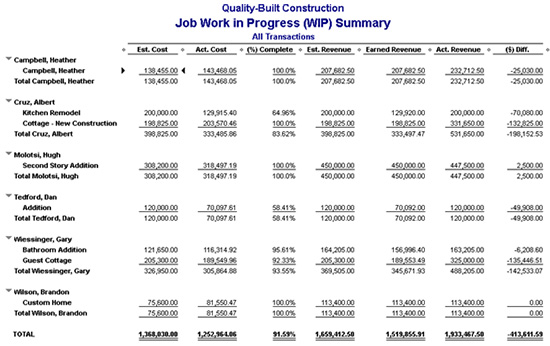
Find the Job Work in Progress Summary by Choosing Reports, then Jobs, Time & Mileage. Then select Job WIP Summary.
Note: Only jobs with a related Estimate transaction in QuickBooks will appear on this report.
When viewing the report, you’ll see an Earned Revenue column. This column provides the amount you’ve earned on the job, regardless of how much you have invoiced to the customer. This is calculated by taking the Estimated Revenue column and multiplying by the (%) Complete column.
The (%) Complete column is derived by dividing The Actual Cost column by the Estimated Cost column. In other words, the report assumes that if you have incurred a certain portion of your total estimated expenses, then that same % of revenue has been earned. In many cases, the amount of earned revenue will vastly differ from the amount that has been invoiced to the customer. The ($) Diff column essentially becomes your “over/under billed” amount and can be used to make the accounting adjustment in QuickBooks.
Note: if a job’s expenses are over budget, the (%) Complete column will assume the job is 100% complete.
© 2017
With school out you might be focused on summer plans for your children (or grandchildren). But the end of the school year is also a good time to think about Coverdell Education Savings Accounts (ESAs) — especially if the children are in grade school or younger.
One major advantage of ESAs over another popular education saving tool, the Section 529 plan, is that tax-free ESA distributions aren’t limited to college expenses; they also can fund elementary and secondary school costs. That means you can use ESA funds to pay for such qualified expenses as tutoring and private school tuition.
Other benefits
Here are some other key ESA benefits:
- Although contributions aren’t deductible, plan assets can grow tax-deferred.
- You remain in control of the account — even after the child is of legal age.
- You can make rollovers to another qualifying family member.
A sibling or first cousin is a typical example of a qualifying family member, if he or she is eligible to be an ESA beneficiary (that is, under age 18 or has special needs).
Limitations
The ESA annual contribution limit is $2,000 per beneficiary. The total contributions for a particular ESA beneficiary cannot be more than $2,000 in any year, no matter how many accounts have been established or how many people are contributing.
However, the ability to contribute is phased out based on income. The phaseout range is modified adjusted gross income (MAGI) of $190,000–$220,000 for married couples filing jointly and $95,000–$110,000 for other filers. You can make a partial contribution if your MAGI falls within the applicable range, and no contribution if it exceeds the top of the range.
If there is a balance in the ESA when the beneficiary reaches age 30 (unless the beneficiary is a special needs individual), it must generally be distributed within 30 days. The portion representing earnings on the account will be taxable and subject to a 10% penalty. But these taxes can be avoided by rolling over the full balance to another ESA for a qualifying family member.
Would you like more information about ESAs or other tax-advantaged ways to fund your child’s — or grandchild’s — education expenses? Contact us!
© 2017
For entrepreneurs seeking a lower-risk, turnkey opportunity, a franchise can be a good fit.
But to help ensure you are making the right choice be sure to consider:
1. Self Assess. Franchise systems are highly structured and best suited to owners willing to follow rules and listen to feedback.
2. Perform Research. Some franchises are better than others. Look for negative media accounts and talk to current franchisees.
3. Be Realistic. Franchises are rarely profitable the first year – and can take even longer to yield a reliable income for owners.
4. Ask the Professionals. A lawyer needs to review your franchise agreement and an experienced CPA should prepare cash-flow projections.
5. Read the FDD. The Financial Disclosure Document covers everything from fees to advertising Litigation Support .
Contact us for more information.
Here are some of the key tax-related deadlines affecting businesses and other employers during the third quarter of 2017. Keep in mind that this list isn’t all-inclusive, so there may be additional deadlines that apply to you. Contact us to ensure you’re meeting all applicable deadlines and to learn more about the filing requirements.
July 31
- Report income tax withholding and FICA taxes for second quarter 2017 (Form 941), and pay any tax due. (See exception below.)
- File a 2016 calendar-year retirement plan report (Form 5500 or Form 5500-EZ) or request an extension.
August 10
- Report income tax withholding and FICA taxes for second quarter 2017 (Form 941), if you deposited on time and in full all of the associated taxes due.
September 15
- If a calendar-year C corporation, pay the third installment of 2017 estimated income taxes.
- If a calendar-year S corporation or partnership that filed an automatic six-month extension:
- File a 2016 income tax return (Form 1120S, Form 1065 or Form 1065-B) and pay any tax, interest and penalties due.
- Make contributions for 2016 to certain employer-sponsored retirement plans.
© 2017
Yeo & Yeo CPAs & Business Consultants, a leading Michigan accounting firm, is pleased to announce that Alex M. Wilson, CPA, Senior Accountant, has been appointed to the Young Professionals Steering Committee for the Leading Edge Alliance (LEA Global). LEA Global is an international professional association of more than 220 independently owned accounting and consulting firms in more than 100 countries.
As a member of the Young Professionals (YP) Steering Committee, Wilson will help coordinate YP efforts nationwide together with the other eight members of the Committee. Their goal is to ensure that YPs across the country have opportunities to help their firms grow and to stand out as industry leaders.
Wilson coordinates Yeo & Yeo’s participation in LEA Global Volunteer Days, held annually in June.Young professionals from member firms worldwide are encouraged to choose a charity they wish to support. Locally, Wilson leads Yeo & Yeo’s professionals firm-wide in donating time and money to local nonprofit organizations throughout Michigan; this year’s Volunteer Days will focus on animal causes.
Wilson works in collaboration with the firm’s Career Advocacy Team (CAT Team). Team members implement new policies and procedures and work to provide equal access to career development, assist women in advancing to leadership positions, and promote the successful integration of personal and professional lives.
“The CAT team recognizes and is consistently impressed with Alex’s leadership role here at Yeo & Yeo. When the CAT team decided to offer a new Summer Leadership Program for college accounting students – an idea brought forth by a few of the young professionals at the firm – Alex and his team stepped up and have been doing an exceptional job of organizing this event,” says John Haag, Principal and leader of the CAT Team.
In May 2017, Wilson attended the Michigan Young Professionals Network Statewide Conference in Mt. Pleasant, Mich. The two-day conference provided a forum for young professionals across the state to connect, build relationships, and share ideas about personal and professional growth. “I was able to connect with many local, young professionals who share the same desires and goals that I have. I learned how YPs can make a difference in both our companies and our communities, which I hope to demonstrate at Yeo & Yeo,” says Wilson.
It’s common for closely held businesses to transfer money into and out of the company, often in the form of a loan. However, the IRS looks closely at such transactions: Are they truly loans, or actually compensation, distributions or contributions to equity?
Loans to owners
When an owner withdraws funds from the company, the transaction can be characterized as compensation, a distribution or a loan. Loans aren’t taxable, but compensation is and distributions may be.
If the company is a C corporation and the transaction is considered a distribution, it can trigger double taxation. If a transaction is considered compensation, it’s deductible by the corporation, so it doesn’t result in double taxation — but it will be taxable to the owner and subject to payroll taxes.
If the company is an S corporation or other pass-through entity and the transaction is considered a distribution, there’s no entity-level tax, so double taxation won’t be an issue. But distributions reduce an owner’s tax basis, which makes it harder to deduct business losses. If the transaction is considered compensation, as with a C corporation, it will be taxable to the owner and subject to payroll taxes.
Loans to the business
There are also benefits to treating transfers of money from owners to the business as loans. If such advances are treated as contributions to equity, for example, any reimbursements by the company may be taxed as distributions.
Loan payments, on the other hand, aren’t taxable, apart from the interest, which is deductible by the company. A loan may also give the owner an advantage in the event of the company’s bankruptcy, because debt obligations are paid before equity is returned.
Is it a loan or not?
To enjoy the tax advantages of a loan, it’s important to establish that a transaction is truly a loan. Simply calling a withdrawal or advance a “loan” doesn’t make it so.
Whether a transaction is a loan is a matter of intent. It’s a loan if the borrower has an unconditional intent to repay the amount received and the lender has an unconditional intent to obtain repayment. Because the IRS and the courts aren’t mind readers, it’s critical to document loans and treat them like other arm’s-length transactions. This includes:
- Executing a promissory note,
- Charging a commercially reasonable rate of interest — generally, no less than the applicable federal rate,
- Establishing and following a fixed repayment schedule,
- Securing the loan using appropriate collateral, which will also give the lender bankruptcy priority over unsecured creditors,
- Treating the transaction as a loan in the company’s books, and
- Ensuring that the lender makes reasonable efforts to collect in case of default.
Also, to avoid a claim that loans to owner-employees are disguised compensation, you must ensure that they receive reasonable salaries.
If you’re considering a loan to or from your business, contact us for more details on how to help ensure it will be considered a loan by the IRS.
© 2017
The Association of Certified Fraud Examiners (ACFE) has published its 2016 Report to the Nations on Occupational Fraud and Abuse. The latest biennial study breaks down white-collar crimes by industry, highlighting the common scams that manufacturers need to watch for and ways for them to minimize potential losses from fraud.
How much does fraud cost?
The ACFE estimates that the annual cost of fraud globally is roughly $3.7 trillion, based on a gross world product of $74.16 trillion in 2014. That’s a significant amount of money, but what hits closer to home is how much fraud affects individual victim organizations.
The median loss for fraud occurring at U.S. companies was $120,000, according to the 2016 report. Even more disheartening is the median loss for manufacturers of $194,000. A loss of this size would be difficult for most small manufacturers to absorb. Moreover, these estimates include only direct monetary losses. Fraud also potentially costs companies in terms of lost productivity, diminished employee morale and loss of confidence with customers.
Which schemes are most common?
The ACFE breaks down its findings by industry, and manufacturing ranks third in terms of the frequency of fraud cases. The most common schemes reported by manufacturers include:
Corruption. Almost half of manufacturers in the study (48.4%) fell victim to these scams. Corruption includes bribery, illegal gratuities and economic extortion.
Billing scams. About one-third of fraud cases (32.8%) involved billing ploys. These scams may include submitting invoices for fictitious goods or services, inflated invoices, or invoices for personal purchases.
Noncash theft. Rounding out the top three categories, noncash ploys were reported in more than 30% of fraud cases. These incidents often involve theft of such valuable assets as inventory and equipment.
In addition, roughly a quarter of fraud cases involved fictitious or exaggerated claims for expense reimbursement. Many fraudsters test the waters with these types of entry-level scams. Then they graduate to bolder schemes, if no one notices their expense fraud.
How can manufacturers fight fraud?
Fraud prevention and detection measures don’t necessarily have to be expensive to be effective. According to the ACFE, the anti-fraud controls that offer the highest potential return on investment — that is, offer the biggest reduction in comparative median fraud losses — include:
- Regular data monitoring and analysis techniques,
- Management review, and
- Reporting hotlines.
Across the board, the presence of anti-fraud controls was correlated with lower losses and quicker fraud detection. More specifically, victim organizations that were using proactive data monitoring and analysis techniques as part of their anti-fraud program suffered fraud losses that were 54% lower and detected the fraud in half the time compared to organizations that didn’t use these techniques. Management review and the presence of a hotline were correlated with 50% lower median losses and 50% less time to detect the scheme.
How should victims handle fraud allegations?
The majority of the fraud victims in the ACFE study haven’t yet recovered a dime from the perpetrators. Many worry that prosecuting criminals could lead to bad publicity. Others prefer to just fire the wrongdoers and then focus on recovery, rather than spend time and resources pursuing a financial settlement or conviction.
Prosecuting fraud may be worthwhile for several reasons, however. It sends a message 100c to would-be thieves that management has adopted a zero-tolerance policy, thereby deterring future crimes. In addition, a conviction will be reported on the fraudster’s permanent record, which may prevent him or her from striking other victims in the future. If you suspect fraud, contact your attorney or a forensic accountant for help deciding how to proceed.
© 2016
Many nonprofit organizations rely on their CPA to prepare Form 990, but there are some key areas that nonprofit managers can help prepare to maximize their Form 990 as a marketing tool. Form 990 has many different users including contributors, funders, and the general public. Because it is public information that anyone can access, users may be looking at your 990 that you do not even know about!
Anywhere that a narrative appears on Form 990, it should be seen as an opportunity for the organization to tell users what the organization does and how its mission is making an impact in the community. The largest area on the form in which to tell the organization’s story is in Part III – Statement of Program Service Accomplishments. In this section, the organization defines its mission and also splits program revenues and expenses between its top three program areas, with a fourth “other” category available if needed. In this section, it is advisable to include current-year program highlights; the more factual and robust the information, the greater the potential impact. Think about adding details about the program names, the number of participants, quantifiable outcomes, etc. Additionally, Schedule O – Supplemental Information to Form 990 or 990-EZ has many answers for various questions on Form 990, including how compensation is set, how conflicts of interest are handled and the review process for the Form 990.
Much like the worded sections, Part IV – Checklist of Required Schedules should be reviewed in detail for any unique items about the organization. Many questions about the nonprofit organization appear on this schedule, including (but not limited to) questions about significant donations, related-party transactions, special events, grant making, lobbying and non-cash contributions. A “yes” answer will require additional information from your Form 990 preparer.
Finally, various sections give readers an idea of the size and scope of the organization. Form 990 discloses the names of officers and directors including their compensation, the number of volunteers, the number of employees, the number of grants given by the organization and details of special event revenue and expenses. An entire section on governance structures and policies is also included.
While there are many other nuanced areas of Form 990, these are three examples of areas that the organization should review in detail annually. While the CPA preparer may have a good idea of what you do, someone at the organization is best suited to describe the day-to-day details. In addition to financial management, consider having a marketing or development staff member read the Form 990 to ensure it is presenting the organization to the public in the best possible way. A properly completed and reviewed Form 990 could be a useful leveraging tool for organizations.
For more information about Form 990, please contact your Yeo & Yeo professional today.
If you recently filed your 2016 income tax return (rather than filing for an extension) you may now be wondering whether it’s likely that your business could be audited by the IRS based on your filing. Here’s what every business owner should know about the process.
Catching the IRS’s eye
Many business audits occur randomly, but a variety of tax-return-related items are likely to raise red flags with the IRS and may lead to an audit. Here are a few examples:
- Significant inconsistencies between previous years’ filings and your most current filing,
- Gross profit margin or expenses markedly different from those of other businesses in your industry, and
- Miscalculated or unusually high deductions.
An owner-employee salary that’s inordinately higher or lower than those in similar companies in his or her location can also catch the IRS’s eye, especially if the business is structured as a corporation.
Response measures
If you’re selected for an audit, you’ll be notified by letter. Generally, the IRS won’t make initial contact by phone. But if there’s no response to the letter, the agency may follow up with a call.
The good news is that many audits simply request that you mail in documentation to support certain deductions you’ve taken. Others may ask you to take receipts and other documents to a local IRS office. Only the most severe version, the field audit, requires meeting with one or more IRS auditors.
More good news: In no instance will the agency demand an immediate response. You’ll be informed of the discrepancies in question and given time to prepare. To do so, you’ll need to collect and organize all relevant income and expense records. If any records are missing, you’ll have to reconstruct the information as accurately as possible based on other documentation.
If the IRS selects you for an audit, our firm can help you:
- Understand what the IRS is disputing (it’s not always crystal clear),
- Gather the specific documents and information needed, and
- Respond to the auditor’s inquiries in the most expedient and effective manner.
Don’t let an IRS audit ruin your year — be it this year, next year or whenever that letter shows up in the mail. By taking a meticulous, proactive approach to how you track, document and file your company’s tax-related information, you’ll make an audit much less painful and even decrease the chances that one happens in the first place.
© 2017
Nonprofits with years ending December 31, 2018, and later will implement the new nonprofit accounting standard, FASB ASU 2016-14, Presentation of Financial Statements of Non-Profit Entities. This new standard is the first significant change to nonprofit accounting in 20 years. The reporting of net assets will change under this standard.
Under current FASB standards, there are three classes of net assets: unrestricted, temporarily restricted, and permanently restricted. However, with changes to relevant laws (UPMIFA) in the past few years, the boundaries between the classes of net assets have been blurred. The new standard will reduce the classes of net assets to those with donor restrictions and those without donor restrictions. On the face, this is a simplification. It takes away determining the nuances of what is permanently restricted versus temporarily restricted. It also clarifies what has always been the case – that restrictions must come from donors.
However, in exchange for this simplification, significantly more disclosures will be required. The disclosures need to include information amount the nature and amounts of different types of donor-imposed restrictions. This disclosure includes things like support of particular operating activities, investment for a specified term, use in a specified future period, etc. Essentially, what was previously disclosed through a combination of the numbers indicating temporarily and permanently restricted net assets, and a narrative disclosure of what those net assets were restricted for, has now been moved completely to the footnotes.
Let’s assume you previously had two different purpose restrictions and a time restriction in temporarily restricted net assets; you had a single line item for temporarily restricted net assets and then typically a general explanation of the purpose restrictions and time restriction in the footnotes, without corresponding dollar amounts. Now you will need to quantify the dollar amount in the footnotes subject to each of the purpose restrictions and the time restriction. If a contribution is subject to both the purpose and time restriction, you will have to list it in a manner that is careful not to double-count it in the footnotes. Also, information about the amounts and purposes of board-designated net assets without donor restrictions shall be provided in the notes or on the face of the financials.
In addition, there are changes to how underwater endowment funds are reported. In the past, when a permanently restricted endowment fund had losses that brought the fair value below the original gift amount, the difference was recorded as unrestricted net assets, so that the permanently restricted net assets were never below the original gift amount. This caused a lot of confusion and additional accounting record keeping. Under the new standard, the fair value of the endowment fund will be the amount reported as with donor restrictions, regardless of whether it is underwater. However, in exchange for that simplification, additional disclosures are required. The entity must disclose:
- their policy and actions taken related to appropriation from underwater endowment funds (such as whether the organization does any appropriations, reduced appropriations, etc. when a fund is underwater),
- the aggregate fair value of underwater endowment funds,
- the aggregate original gift amounts of the underwater endowments, and
- the aggregate amount by which endowments are underwater.
Contributions of long-lived assets previously had an accounting election to determine if they were released from restriction using a placed-in-service approach or over their estimated useful life. As part of the simplification effort, FASB will require all nonprofits to use the placed-in-service approach, unless there are explicit donor stipulations.
Overall, less detail will be required on the face of the financial statements. This may allow for easier accounting in some cases. However, all of the information that was previously needed for the face of the financial statements will now be disclosed in the footnotes, and in many cases will be disclosed in more detail than previously required. In the midst of all the transition, ensure that the required information is readily available to make those required disclosures.
The statement focuses on two criteria:
1) Is the government controlling the assets of the fiduciary activity?
2) Who are the beneficiaries with whom fiduciary relationships exist?
Additional criteria identify fiduciary component units and post-employment benefit arrangements that are fiduciary activities. What does this mean for your government? If your government has an activity that meets the criteria, then you will report a fiduciary fund in the basic financial statements.
- Governments will present a statement of fiduciary net position and a statement of changes in net fiduciary position. The statement of changes in fiduciary net position is a new, required statement for all fiduciary activities. Previously, it was only required for governments that reported a trust fund.
- Instead of recording an asset with a corresponding liability, governments will now need to account for the fiduciary activity like a special revenue fund that includes additions and deductions.
The statement specifies four fiduciary funds that should be reported: 1) pension (and other employee benefit) trust funds, 2) investment trust funds, 3) private-purpose trust funds, and 4) custodial funds. Custodial funds generally should report fiduciary activities that are not held in a trust or equivalent arrangement that meets the specific criteria.
Unlike the previous GASB statements that have been released in the past couple of years, this statement will change the majority of governmental financial statements. It is important to know the effective date of this statement so that you have time to plan and set up new chart of account numbers to start the year of implementation on the right foot. This statement is effective for reporting periods beginning after December 15, 2018.
If you have questions or need assistance, contact Yeo & Yeo.
Summer is upon us, which means schools are out and kids of various ages will be looking for summer jobs. As always, the agriculture industry will continue to offer many opportunities for summer employment for teenagers. However, the laws and regulations for youth employment in agriculture differ from nonfarm jobs, so be sure to understand and follow the rules.
The Fair Labor Standards Act of 1938 (FLSA), as amended, is the governing document when it comes to agriculture jobs. The FLSA covers employees whose work involves the production of agricultural goods that leave the state directly or indirectly and become part of interstate commerce.
The minimum age standards for agricultural employment set by the FLSA* are as follows:
- Youths age 16 and above may work in any farm job at any time.
- Youths ages 14 and 15 may work outside school hours in jobs not declared hazardous by the Secretary of Labor.
- Youths ages 12 and 13 may work outside of school hours in non-hazardous jobs on farms that also employ their parent(s) or with written parental consent.
- Youths under age 12 may work outside of school hours in a non-hazardous job with parental consent, but only on farms where none of the employees are subject to the minimum wage requirements of the FLSA.
- Youths ages 10 and 11 may hand-harvest short-season crops outside school hours for no more than eight weeks between June 1 and October 15, if their employers have obtained special waivers from the Secretary of Labor.
- Youths of any age may work at any time in any job on a farm owned or operated by their parents.
Be aware that many states have their own laws for youth employment in agriculture. When both state and federal youth employment laws apply, the law setting the most stringent standard must be observed. Michigan generally follows the federal laws except for operations involving detasseling, roguing, hoeing or similar work in the production of seed.* For those types of operations, students must be age 16 or older to work during school hours or age 13 or older during non-school hours. These students are also subject to maximum daily and weekly hour limitations.
To help make sure you are in compliance with these laws and regulations, follow these best practices:
- Properly verify all minor workers’ ages and keep good records.
- Review and understand what is considered hazardous work for agriculture employees.
- Make sure all of your minor employees are clear on what jobs they may and may not do.
- Regularly review safety procedures with all of your employees.
- Keep copies close at hand of any certifications that 14- and 15-year olds may have completed for machinery operation courses offered through vocational schools or 4-H.
An employer who violates the youth employment provisions may be subject to civil penalties, based on the specific circumstances of each case. These laws are enforced by investigators of the Wage and Hour Division of the Secretary of Labor. These investigators have the authority to conduct investigations and gather data on wages, hours, and other employment conditions or practices to assess compliance with all the provisions of the FLSA.*
Additional information can be obtained from the Wage and Hour Division’s website at http://www.wagehour.dol.gov or by calling the toll-free information helpline at 1-866-487-9243.
*Source: U.S. Department of Labor website, Child Labor Bulletin No. 102. Other portions of this article were also excerpted from the U.S. Department of Labor’s website.
Once taxpayers turn age 70½, required minimum distributions (RMDs) must be made annually from any non-Roth IRA accounts. These amounts are calculated each year, based on the total amount in the IRA and the taxpayer’s (and spouse’s, if applicable) ages. Over the years, Congress has passed provisions allowing for Qualified Charitable Distributions (QCDs) from these accounts; however, often the legislation was passed retroactively just before the end of the year, limiting planning and usage 100c. That has changed because part of the PATH Act of 2015 extends these provisions permanently. This is great news for charitable taxpayers with IRAs, as making use of the QCD deduction benefits taxpayers of many income levels.
How does it work?
Taxpayers age 70½ or older direct their IRA trustee to make a distribution check directly payable to the charity. The charity then must provide an acknowledgment of the gift. Then on Form 1040, the taxpayer reports the full amount of any IRA distributions on line 15a, but then subtracts any QCDs to get to the taxable amount on line 15b. If all IRA distributions are given directly to charity, the taxpayer would report zero on line 15b.
Isn’t this the same as itemizing?
No, it is not. When a taxpayer itemizes, the entire amount of the IRA distribution is included in Adjusted Gross Income (AGI), and the charitable amount is then added to Schedule A, as part of itemized deductions. Those deductions are then subtracted to arrive at taxable income only if they exceed the standard deduction amount ($15,100 for a couple in their 70s filing jointly). Including the IRA distributions in AGI can then affect the amount of Social Security income that is taxable, as well as raise the threshold needed to deduct medical and miscellaneous amounts on Schedule A. Using a QCD lowers the taxpayers’ AGI.
Part of the beauty of a QCD is that even people who don’t itemize can take advantage of it, be it people who donate thousands of dollars, or hundreds of dollars. Including charitable donations on Schedule A often does not benefit a taxpayer because itemized deductions may not exceed the standard deduction, especially once mortgages are paid off later in life and portions of the taxpayer’s retirement income is not taxable at the state level. For those whose retirement income is taxed at the state level, using a QCD may also lower state taxes, as using a QCD will directly reduce AGI.
Following is an example using 2016 tax rates for a couple in their 70s who receive a $20,000 IRA distribution, along with $50,000 in Social Security income. They donate $5,000 annually to various charities. As you can see below, using QCDs for the charitable donations instead of the taxpayers receiving the distributions and then making the donations results in federal tax savings of $1,758!
|
|
Taxable Without QCD | Taxable With QCD |
| IRA, $20,000 RMD, $5,000 to charity | $20,000 | $15,000 |
| Social Security $50,000 | $6,850 | $ 4,000 |
| Standard Deduction | $15,100 | $15,100 |
| Federal Tax | $1,758 | $0 |
What to do next
Specific rules must be followed to allow for this preferred treatment, which include not exceeding the limit of $100,000 per taxpayer (and each taxpayer may use only his or her account to make the QCD). Gifts must be made from an individual IRA, which includes rollover IRAs, but not from a SEP or SIMPLE IRA. Qualifying charitable gifts may be made only to public charities—private foundations, donor advised funds and split interest charitable trusts are ineligible. Checks must be made payable directly to the charity; however, the taxpayer may have the check sent to him or her to then distribute to the charity personally. Finally, the taxpayer must be at least 70½ on the date of the gift, not just in the tax year in which the donation is made.
To determine if this is something that would benefit you, contact your tax advisor for more guidance on how to get the most benefit from your RMD.
If your employees incur work-related travel expenses, you can better attract and retain the best talent by reimbursing these expenses. But to secure tax-advantaged treatment for your business and your employees, it’s critical to comply with IRS rules.
Reasons to Reimburse
While unreimbursed work-related travel expenses generally are deductible on a taxpayer’s individual tax return (subject to a 50% limit for meals and entertainment) as a miscellaneous itemized deduction, many employees won’t be able to benefit from the deduction. Why?
It’s likely that some of your employees don’t itemize. Even those who do may not have enough miscellaneous itemized expenses to exceed the 2% of adjusted gross income floor. And only expenses in excess of the floor can actually be deducted.
On the other hand, reimbursements can provide tax benefits to both your business and the employee. Your business can deduct the reimbursements (also subject to a 50% limit for meals and entertainment), and they’re excluded from the employee’s taxable income — provided that the expenses are legitimate business expenses and the reimbursements comply with IRS rules. Compliance can be accomplished by using either the per diem method or an accountable plan.
Per Diem Method
The per diem method is simple: Instead of tracking each individual’s actual expenses, you use IRS tables to determine reimbursements for lodging, meals and incidental expenses, or just for meals and incidental expenses. (If you don’t go with the per diem method for lodging, you’ll need receipts to substantiate those expenses.)
The IRS per diem tables list localities here and abroad. They reflect seasonal cost variations as well as the varying costs of the locales themselves — so London’s rates will be higher than Little Rock’s. An even simpler option is to apply the “high-low” per diem method within the continental United States to reimburse employees up to $282 a day for high-cost localities and $189 for other localities.
You must be extremely careful to pay employees no more than the appropriate per diem amount. The IRS imposes heavy penalties on businesses that routinely fail to do so.
Accountable Plan
An accountable plan is a formal arrangement to advance, reimburse or provide allowances for business expenses. To qualify as “accountable,” your plan must meet the following criteria:
- It must pay expenses that would otherwise be deductible by the employee.
- Payments must be for “ordinary and necessary” business expenses.
- Employees must substantiate these expenses — including amounts, times and places — ideally at least monthly.
- Employees must return any advances or allowances they can’t substantiate within a reasonable time, typically 120 days.
If you fail to meet these conditions, the IRS will treat your plan as nonaccountable, transforming all reimbursements into wages taxable to the employee, subject to income taxes (employee) and employment taxes (employer and employee).
Whether you have questions about which reimbursement option is right for your business or the additional rules and limits that apply to each, contact us. We’d be pleased to help.
© 2017