Yeo & Yeo to Present at Michigan School Business Officials Conference
The Michigan School Business Officials Annual Conference will be held at the DeVos Place in Grand Rapids, May 2-4. Members of Yeo & Yeo’s Education Services Group will present four of the sessions. We welcome you to join us to gain new insights into managing your Michigan school.
- Ethics Dilemmas and Fraud & Forensics Prevention – Molly Fish, CPA
Learn about the common ethical dilemmas that arise in school districts and examine examples of actual Fraud & Forensics that has occurred at local school districts. Find out what you can do to prevent it from happening at your district.
- The ABCs of Your District’s Single Audit – Jennifer Watkins, CPA
Learn how to prepare for your single audit, including the Schedule of Expenditures of Federal Awards (SEFA) preparation and common findings. Learn the changing requirements of a single audit.
- Ask the Auditor – David Youngstrom, CPA, and Brian Dixon, CPA
Have an off-the-record discussion with experienced school auditors in a “penalty free” zone. Whether you have been doing this for years or are just starting out, bring your questions or your scenarios to get instant feedback!
- cybersecurity – Kristi Krafft-Bellsky, CPA
Find out how to verify that your information is protected and what you should be asking as a technology director.
We encourage you to attend. Register and learn more about the MSBO Annual Conference.
Nonprofits with years ending December 31, 2018, and later will implement the new nonprofit accounting standard, FASB ASU 2016-14, Presentation of Financial Statements of Non-Profit Entities. This new standard is the first significant change to nonprofit accounting in 20 years. One of the key changes in this standard relates to functional expenses.
Under the current standards, voluntary health and welfare organizations must present a statement of functional expenses that breaks down, in a grid format, natural and functional expense classifications. Also, all nonprofits must report their expenses on a functional basis, which can be done on the face of the statement of activities, in a statement of functional expenses, or in a footnote to the financials. Under the new standard, all nonprofits will be required to provide an analysis of expenses by their nature and function.
For voluntary health and welfare organizations, this will look very similar to the current statement of functional expenses, as a statement is one manner in which the information can be provided. For other organizations, this will be a brand new statement or extensive footnote; we recommend a statement for most organizations. Theoretically, those other organizations should have already had a supporting schedule in their work papers to their financial statements showing how they got from the natural expenses to the functional classifications, but many organizations may have simply taken a percentage estimate in total.
Start planning now
If your organization has not previously done a statement of functional expenses, you need to start planning now for how you will obtain the information to be able to create, essentially, a statement of functional expenses. Consider if this is something that should be done via direct allocation as expenses are recorded, and thus may necessitate a change in your chart of accounts structure, or if it is best done using an indirect allocation during the financial statement preparation process. Either way, changes to the internal control structure may be necessary to track the information to properly allocate these expenses in a grid showing natural and functional expenses.
Investment expenses
However, even for those who previously did a statement of functional expenses, there are a few changes. Previously GAAP allowed the netting of investment expense with investment return. Some organizations did this and others did not. Most of the time those expenses were direct expenditures to third parties for investment fees and management. This new standard removes the option, and external investment expenses, as well as direct internal investment expenses, must be netted with investment income.
Organizations may not have procedures in place to track the direct internal investment expenses or to allocate them using an indirect allocation. These expenses include the direct conduct or direct supervision of the strategic and tactical activities involved in generating investment return. For example, if your executive director is involved in the due diligence process for changing investment firms – or if your investment firm provides quarterly meetings that your Controller attends to learn about the investment strategies and options – the time for those is an investment expense that must be netted against investment revenue. Most entities have just considered that internal investment expense to be management and general.
Do be aware, for entities like community foundations, where investing is part of the programmatic achievements, their accounting will not change and their investment income, because it is programmatic, will remain gross. This will involve changes in internal controls over time tracking and possibly expense documentation. It may also involve a change to the chart of accounts to allow those expenses to be broken out in the trial balance.
Other changes
Traditionally certain things may have been excluded or included in the statement of functional expenses that will need to change under the new standard.
- Gains and losses are specifically excluded from this analysis of expenses by nature and function; by definition they are not expenses.
- Certain special event expenses, if the special event is not major and ongoing, have traditionally been netted against revenues. Although they can continue to be netted against revenues, they will also need to appear in this analysis of expenses by nature and function. Also, they have to be included based on the nature of the expense. For example, if you have a gala event that meets the requirements that the special event expenses can be netted against revenues, under the new standard those expenses will need to be in the analysis of expenses by nature and function, and they will go to line items like salaries, entertainment, rent, food, and not to a single line item like gala event.
- Cost of goods sold also has to be broken out by nature, and not just lumped together as one line. This is another area that likely will require either an expansion of the chart of accounts or more detailed recordkeeping.
Management and general expenses vs. program expenses
FASB also strengthened the example of what is management and general versus what is program. Program expenses include the direct conduct or direct supervision of programmatic purposes; they do not include general overall supervision. For example, the program department director reports to the executive director and keeps the executive director in the know about programs; this is not direct conduct or direct supervision on the executive director’s part. However, the program department director is out on medical leave and during that time the executive director is giving directions and following up to specifically manage the staff in the program department to ensure the program is being accomplished; this is direct supervision and would be allocable to program expenses.
The standard calls out financial reporting for grants as being specifically management and general, too. Although we do not believe the intent of the standard has changed, many organizations had different interpretations of the original standard and will see additional management and general expenses under the new standard.
Organizations should start discussing these changes with management, the board, and funding sources to prepare them for changes in the program service expense percentages.
MAS 90 is a brand that has stood the test of time and has become a standard within the manufacturing industry. Manufacturers have relied on the robust, feature-rich application to manage their business processes, from receiving quotes to producing orders and shipping their products on time.
Did you know that the name of the software is no longer MAS 90? Although many users still refer to the software as MAS 90, it has been upgraded and is now called sage 100cloud. Dashboards can be connected through Business Intelligence, financials through Sage 100cloud Intelligence, and exception monitoring and alerting through sage 100c Alerts & Workflow, to name a few. The emphasis with Sage 100cloud is to give you more information so you can make better decisions and be that trusted name for your customers.
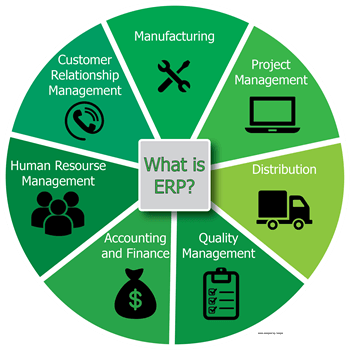
What is ERP solution?
ERP solution software unifies the systems your organization uses every day – everything from product development and supply chain management, to distribution management and more. ERP solution software utilizes a suite of business applications designed to improve business management and help you focus on core business. Organizations use ERP solution software to manage and organize the data that makes their business run. When you bring on the right ERP solution system, you will have access to better collaboration, reporting data, productivity, and maximized production.
ERP solution technology offers substantial benefits. Contact Yeo & Yeo Technology to learn more about Sage 100cloud erp solution software.
A slew of different construction-focused accounting systems are available, but not all of them may be a good option for your company. For the small- and medium-size company, some of the dedicated systems can be too robust or too pricey to be a viable option. For this reason, many companies have turned to QuickBooks for their accounting needs. Construction owners and managers can successfully utilize this platform with the help of various add-on applications.
Intuit’s website describes the many different Intuit-approved applications that will integrate seamlessly with the various QuickBooks platforms. These add-ons give users functionality that is not built into the basic QuickBooks system. Below are a few examples of popular construction-related add-ons and what they can do for users.
- Corecon
Corecon is an overall project management software. With Corecon, contractors can easily monitor their job costs, build accurate estimates and bids, and schedule jobs. Corecon also gives staff working on job sites the ability to enter their logs and timecards through a mobile app.
- RedTeam
RedTeam assists contractors with the internal management of jobs. With this app, contractors can do paperless posting and approval of vendor and subcontractor invoices, easily track subcontractor insurance and other credentials, and track revenue based on each job’s percentage of completion.
- Knowify for Contractors
Knowify is made specifically for residential contractors. It gives these companies the ability to build bids for both general contractor jobs as well as smaller jobs with property owners. It helps contractors estimate jobs and track job costs once it has begun, support both standard and AIA-style invoicing, maintain online schedules, and create and automatically send purchase orders to vendors.
The above are just a few examples of the different add-ons that are available; many more are offered that can help construction contractors manage documents, generate advanced reporting, simplify payroll and optimize productivity.
Call on the members of Yeo & Yeo’s Computer Accounting Software Solutions Team who hold QuickBooks accreditations and can help you choose software that will provide the most substantial benefits for your construction business.
Auto-enrolling 401(k) plan participants without also incorporating an auto-escalation feature might be a counterproductive exercise. J.P. Morgan Asset Management survey data suggests that average 401(k) plan deferral rates have been trending downward even though more employers are adopting auto-enrollment. The apparent culprit: low auto-deferral rates.
Stats tell the story
From 2012 to 2014, the average annual contribution rate was 7.2%. This is down slightly from the 7.4% average in the prior two-year period, and well below the 8% average during 2007 to 2008.
Even though 45% of surveyed employers auto-enroll new participants, just 31% have auto-escalation features built in. One interesting note from the study: For plans with at least $200 million in assets, the numbers are considerably higher — 62% of these high-asset plans have automatic enrollment and 48% use auto-escalation clauses.
The most common auto-enrollment default deferral rate is only 3%, according to the most recent Defined Contribution Institutional Investment Association (DCIIA) survey. Participants who defaulted into such a low deferral rate generally do not increase it significantly. With typical annual auto-increase increments of only 1%, it will take new employees several years to begin deferring at reasonable levels, and many more to reach the 15% that DCIIA sees as ideal.
The DCIIA survey reveals impressive deferral rates for plans that both auto-enroll and auto-escalate participants. “Plan sponsors who offer both automatic enrollment and automatic contribution escalation have over twice as many participants with retirement savings rates over 15% (14% of respondents) as those that do not offer both (6% of respondents),” according to the survey.
Change is in the air
So why don’t plan sponsors implement these features? According to the survey, plan sponsors with less than $50 million in plan assets were concerned about complaints from participants (28%) and feared it would be seen as paternalistic (18%). And a whopping 31% have never considered using it.
But the DCIIA study concluded that, when properly implemented, automatic features can make a positive difference. Contact your benefits specialist to learn how to use both auto-enrollment and auto-escalation clauses to help benefit your employees.
© 2016
Manufacturers across the country have become a main target for cybercriminals. The news, trade journals, and professional organizations such as the Michigan Manufacturers Association all have stressed the importance of manufacturers becoming aware of this growing threat.
- IBM released a study in 2016 titled, X-Force Research 2016 cybersecurity Intelligence Index, which found that the manufacturing sector was second only to healthcare as the most attacked industry in the country.
- The most recent Carbon Black Threat Report places the manufacturing industry at the top of the target lists for ransomware and malware.
- According to the Ponemom Institute, the average price for a small business to clean up after they have been hacked stands at $690,000; for mid-market companies, it is more than $1 million.
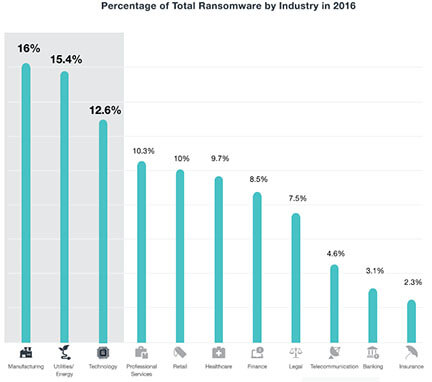
The Carbon Black Threat Report states that when considering the total amount of ransomware seen in 2016, manufacturing companies (16% of total ransomware instances), utility/energy companies (15.4% of all ransomware instances) and technology companies (12.6% of all ransomware instances) led the way.
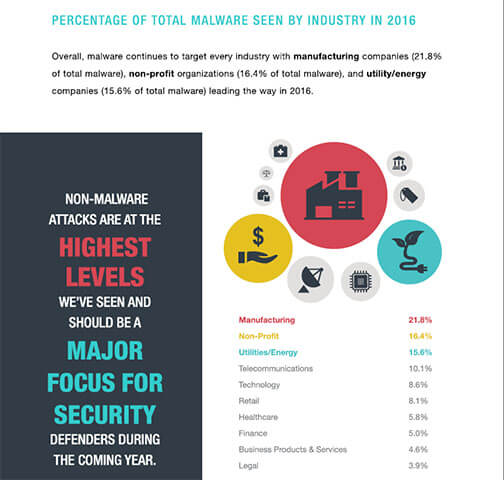
The Carbon Black Threat Report also states that overall, malware continues to target every industry with manufacturing companies (21.8% of total malware), non-profit organizations (16.4% of total malware), and utility/energy companies (15.6% of total malware) leading the way in 2016.
Percentage of Total Malware Seen by Industry in 2016
What should manufacturers do?
What can manufacturers do to protect their organizations? It starts with understanding the threats and risks that exist and how to defend against them. Cybersecurity protection has become a requirement for manufacturers who do business with several agencies and they must be compliant as soon as December 2017. If you are unsure of your organization’s cybersecurity needs or risks, it is important to partner with a technology firm that has expertise in this area.
Next Generation firewall, anti-virus and spam protection services – together with proactively monitoring and managing your network hardware, software, and data traffic – can effectively reduce the risk of a disastrous attack. But firewalls and the best security systems in the world cannot stop everything. Manufacturers should also consider implementing a security awareness training program, which has proven to improve many security flaws. By making employees the first line of defense, manufacturers have a cost-effective way to strengthen the security of their organization.
Call on the members of Yeo & Yeo’s Manufacturing Services Group, who can help you understand and protect your business with industry best practices and technology solutions.
There is a common scene in popular literature, television shows and movies. The family of a wealthy individual gathers in an attorney’s well-appointed office to hear the reading of a recently deceased’s will. Each member usually represents a given stereotype — the spendthrift, the frugal one, the outsider — and, together, they wait impatiently for the attorney to reveal what they are getting.
In real life, this is not how an estate plan should work. To keep the mystery to a minimum, it is a good idea to hold occasional, if not regular, family meetings about your estate plan. Let’s look at some key points to consider when setting up these critical and informative gatherings.
Guest list
Whom should you invite? Start with your spouse, children and other family members who will be affected by your plan (either by their inclusion or exclusion). You should also invite any nonfamily members you will ask to serve as executors, trustees, agents, or guardians of minor children.
Also, request the presence of key advisors such as your attorney and accountant. They can be of service for two important reasons:
1. Questions and answers. Advisors can help answer questions about how your plan works. The legal machinations of an estate plan are complex, and the tax laws involved are not simple either. Your family will better understand the details of your plan if an expert explains them.
2. Team building. The meetings create an opportunity for your family, representatives and advisors to get to know one another. Getting acquainted now will help them build trust and, thereby, improve the chances that your plan will operate smoothly when the time comes for it to do so.
Agenda items
The meetings will need to include a number of agenda items. For starters, you should review the key documents that make up your plan and let everyone know where they are located. In addition, provide an overview of the estate planning decisions you have made so far and — most important — the reasoning behind them.
Many people simply divide their assets equally among their heirs. But in estate planning, equal is not necessarily fair. For example, let’s suppose Tara has adult children from a previous marriage and younger children from her current marriage. She put her older children through college years ago, and now they are gainfully employed and financially independent.
Fairness would dictate that Tara’s estate plan favor her younger children, who will need the money for tuition and living expenses. But her older children may not see it that way unless she explains it to them. A family meeting provides an opportunity for that discussion.
Other issues to discuss include charitable giving, the treatment of assets with special significance — such as vacation homes or family heirlooms — and decisions about which family members are chosen to be guardians, executors and so on.
Business matters
Family meetings are particularly valuable when a family business is involved. It may seem fair to provide a greater share to family members who work in the business.
But what if most of your wealth is tied up in the business? How do you provide for those who do not work in the business while still rewarding the “sweat equity” of those who do?
One option is to divide ownership equally but to use voting and nonvoting stock to give management control to family members who work in the business. Another option is to leave the business to those who work in it and use life insurance to create an inheritance for those who do not. Whatever the solution, the best way to avoid conflict and resentment is to discuss the issue with all interested parties and get their input.
Comforting experience
The thought of sitting down with family members and discussing what eventually is to become of your estate may seem awkward. But, often, the most uncomfortable meeting is the very first one. Once the topic is broached and the details are being discussed, many families find the experience comforting and informative. Again, involve your advisors in the planning and carrying out of the meetings and the process is likely to go much more smoothly.
© 2015
Because of a weekend and a Washington, D.C., holiday, the 2016 tax return filing deadline for individual taxpayers is Tuesday, April 18. The IRS considers a paper return that’s due April 18 to be timely filed if it’s postmarked by midnight. But dropping your return in a mailbox on the 18th may not be sufficient.
An example
Let’s say you mail your return with a payment on April 18, but the envelope gets lost. You don’t figure this out until a couple of months later when you notice that the check still hasn’t cleared.
You then refile and send a new check. Despite your efforts to timely file and pay, you’re hit with failure-to-file and failure-to-pay penalties totaling $1,500.
Avoiding penalty risk
To avoid this risk, use certified or registered mail or one of the private delivery services designated by the IRS to comply with the timely filing rule, such as:
- DHL Express 9:00, Express 10:30, Express 12:00 or Express Envelope,
- FedEx First Overnight, Priority Overnight, Standard Overnight or 2Day, or
- UPS Next Day Air Early A.M., Next Day Air, Next Day Air Saver, 2nd Day Air A.M. or 2nd Day Air.
Beware: If you use an unauthorized delivery service, your return isn’t “filed” until the IRS receives it. See IRS.gov for a complete list of authorized services.
Another option
If you’re concerned about meeting the April 18 deadline, another option is to file for an extension. If you owe tax, you’ll still need to pay that by April 18 to avoid risk of late-payment penalties as well as interest.
If you’re owed a refund and file late, you won’t be charged a failure-to-file penalty. However, filing for an extension may still be a good idea.
We can help you determine if filing for an extension makes sense for you — and help estimate whether you owe tax and how much you should pay by April 18.
© 2017
Audits don’t have to be stressful with proper preparation.
Yeo & Yeo has streamlined its approach to audits. We have implemented procedures to complete the audit efficiently using state-of-the-art technology and our knowledge of ever-changing audit and accounting standards. Our approach balances compliance with providing superior services at competitive pricing.
Download my presentation, Preparing for a Headache-free Audit, to become familiar with the audit process and learn tips and trick for preparation.
If your organization receives federal funds, whether from a pass-through entity, such as the State of Michigan, or directly from the federal government, you need to be aware that the Uniform Grant Guidance 2 CFR 200 is now applicable. I encourage you to stay informed and not to fear because UGG can be more streamlined than you originally believed.
Download my presentation, Don’t Say UGH! to UGG Procurement, for a brief summary of the changes.
Kati Krueger of Yeo & Yeo’s Medical Billing affiliate, a provider of practice management consulting and medical billing services, attended the Medical Billing Executive Conference held March 13-15, 2017, in New Orleans.
The three-day conference provided medical billing executives with an in-depth understanding of important industry developments including:
- New Medicare quality payment program and 2017 billing updates
- How to maximize medical practice revenue
- Physician revenue cycle management 2020 – a three-year outlook
- Performance benchmarks for physician practices
“The conference provided benchmarks for medical billing service providers and their clients, updates, and insight as to what services we may offer our clients in the future. Attending conferences of this caliber increases our depth of knowledge and is critical for us to proactively advise our clients,” says Krueger, vice president of Yeo & Yeo’s Medical Billing affiliate.
More than 50 medical billing executives from throughout the country attended training sessions to help them manage their medical billing companies more effectively, discuss critical issues and share best practices and solutions.
Yeo & Yeo CPAs & Business Consultants, a leading Michigan accounting firm, has been named one of West Michigan’s Best and Brightest Companies to Work For by the Michigan Business & Professional Association for the thirteenth consecutive year.
The annual competition is a program of the Michigan Business & Professional Association (MBPA) and identifies organizations that display a commitment to exceptional human resources practices and employee enrichment. Organizations are assessed based on categories such as communication, employee engagement and retention, education and development, compensation and benefits, diversity, work-life balance, community initiatives and more. This year, 627 companies completed the entire application process. The winning companies will be honored at MBPA’s annual Workforce Symposium & Awards Luncheon on May 3 in Grand Rapids.
“We are honored to be recognized as one of the Best and Brightest Companies to Work For. We are especially proud because we were compared to not only prominent companies in the greater Kalamazoo area, but also those in many other large Michigan cities such as Lansing, Grand Rapids and Mt. Pleasant,” says Carol Patridge, CPA, managing principal of Yeo & Yeo’s Kalamazoo office.
Mark Perry, CPA, managing principal of Yeo & Yeo’s Lansing office says, “We are very proud of our dedicated employees and our positive work environment. I am happy to see our employees are reporting that they are engaged and enriched through their work.”
Yeo & Yeo offers rewarding careers for individuals who have the desire and drive to grow as leaders in the accounting profession. More than 200 employees in offices throughout Michigan take pride in the firm’s reputation for personal service, commitment to clients and community support.
Yeo & Yeo has a culture of developing future leaders through its in-house training department, professional development training and formal mentoring while sustaining work-life balance. The firm also offers an award-winning CPA certification bonus program. Yeo & Yeo employees benefit from collaboration across offices and teams and have access to advisors and resources that help them succeed.
Here are some of the key tax-related deadlines affecting businesses and other employers during the second quarter of 2017. Keep in mind that this list isn’t all-inclusive, so there may be additional deadlines that apply to you. Contact us to ensure you’re meeting all applicable deadlines and to learn more about the filing requirements.
April 18
- If a calendar-year C corporation, file a 2016 income tax return (Form 1120) or file for an automatic six-month extension (Form 7004), and pay any tax due. If the return isn’t extended, this is also the last day to make 2016 contributions to pension and profit-sharing plans.
- If a calendar-year C corporation, pay the first installment of 2017 estimated income taxes.
May 1
- Report income tax withholding and FICA taxes for first quarter 2017 (Form 941), and pay any tax due. (See exception below.)
May 10
- Report income tax withholding and FICA taxes for first quarter 2017 (Form 941), if you deposited on time and in full all of the associated taxes due.
June 15
- If a calendar-year C corporation, pay the second installment of 2017 estimated income taxes.
© 2017
Do you love playing slots at the casino, but state taxes are cutting into your fun? Perhaps the daily winnings method for reporting slots winnings is for you.
Using the daily winnings method, taxpayers report winnings only from gambling sessions in which they have a real economic gain.
For example, Joe goes to the casino on Friday and plays slots until midnight. He spends $2,000, hits one big jackpot for $1,500, and ultimately spends that, going home with only a 1099-G for $1,500. Under the “ordinary” method, Joe would report the $1,500 on his tax return and pay state income tax on that amount. In Michigan, this would be $64. Using the daily winnings method, he would report $0 in winnings for that session of gambling, since for economic purposes he actually lost $2,000.
Now let’s say that Joe goes back to the casino the next week and plays on and off for a few days. His ins and outs activity is as follows:
| Day | Ins | Outs | Real Win/Loss | 1099-Gs |
| Monday | 15,000 | 16,000 | 1,000 | 5,000 |
| Tuesday | 7,000 | 4,000 | (3,000) | 1,200 |
| Wednesday | 2,000 | 2,500 | 500 | 0 |
| Thursday | 7,500 | 7,000 | (500) | 0 |
| Friday | 20,000 | 18,000 | (2,000) | 3,000 |
| Total | 51,500 | 47,500 | (4,000) | 9,200 |
In the chart above, you can see that overall Joe lost $4,000 with his slots activity; however, for income tax purposes, he has $9,200 in income to report. Doing this in the “normal” way for his federal taxes he would have $9,200 in additional income included on the front of his return at line 21. He would then subtract that $9,200 as part of his itemized deductions on Schedule A. But what if he doesn’t itemize? What if he would normally take the standard deduction? If that is the case, he is being taxed on his losses! And for state income tax purposes, he will probably be paying tax on the full $9,200. In Michigan, this amounts to nearly $400!
Using the alternative daily winnings method, Joe would instead report just the Monday and Wednesday winnings, totaling $1,500. If he itemizes, he would have offsetting losses on his Schedule A. For state taxes, he would pay tax on just the $1,500, which in Michigan would translate to a little over $60.
To report in this way, a taxpayer will need the detailed daily ins/outs report that tracks play electronically from each casino. For the occasional slot-player, this method may not make a huge difference, but for those who play regularly, using this method can result in significant savings.
Note that this material has been prepared for informational purposes only. Additional technical requirements apply, so please consult a tax professional to assist you in using this method.
If you have a child in college, you may be eligible to claim the American Opportunity credit on your 2016 income tax return. If, however, your income is too high, you won’t qualify for the credit — but your child might. There’s one potential downside: If your dependent child claims the credit, you must forgo your dependency exemption for him or her. And the child can’t take the exemption.
The limits
The maximum American Opportunity credit, per student, is $2,500 per year for the first four years of postsecondary education. It equals 100% of the first $2,000 of qualified expenses, plus 25% of the next $2,000 of such expenses.
The ability to claim the American Opportunity credit begins to phase out when modified adjusted gross income (MAGI) enters the applicable phaseout range ($160,000–$180,000 for joint filers, $80,000–$90,000 for other filers). It’s completely eliminated when MAGI exceeds the top of the range.
Running the numbers
If your American Opportunity credit is partially or fully phased out, it’s a good idea to assess whether there’d be a tax benefit for the family overall if your child claimed the credit. As noted, this would come at the price of your having to forgo your dependency exemption for the child. So it’s important to run the numbers.
Dependency exemptions are also subject to a phaseout, so you might lose the benefit of your exemption regardless of whether your child claims the credit. The 2016 adjusted gross income (AGI) thresholds for the exemption phaseout are $259,400 (singles), $285,350 (heads of households), $311,300 (married filing jointly) and $155,650 (married filing separately).
If your exemption is fully phased out, there likely is no downside to your child taking the credit. If your exemption isn’t fully phased out, compare the tax savings your child would receive from the credit with the savings you’d receive from the exemption to determine which break will provide the greater overall savings for your family.
We can help you run the numbers and can provide more information about qualifying for the American Opportunity credit.
© 2017
Looking forward at the next three to five years, many professionals think that the industry will slow down some to a more consistent level of growth, compared to the rapid growth we saw in the market over the last few years. A few key factors will lead to the decline in new-build projects:
- Other sectors in the economy are not as strong, so new construction projects are not going to be as prevalent.
- The international market is also seeing an economic slowdown, so new opportunities in the United States will not be as prominent.
- Labor and financing issues will remain a factor, and even more so now with financial institutions believing the construction economy will slow.
It is still being forecast that 2017 will be a good year in the industry, but it will be crucial that construction companies start planning for a downturn.
Construction owners can employ strategies to ensure that they thrive going into the future.
- First, finding good help is hard to do, but it may be just as hard to hold on to that help. Even though it will add more costs, keeping your employees well-compensated will serve your company well. This will keep efficiency high and allow the company to stay on track during projects.
- Second, with lenders tightening on the financing for construction companies, it is vital to keep financial information as accurate as possible. Consistency in the way you estimate a contract will help keep cash flow strong. If you are finishing jobs with little change in the anticipated margin, the bottom line of the company will remain healthy, and lenders will be more likely to finance your operations.
- Finally, keeping a cash flow reserve for the down times will be key in ensuring that your company endures any decline in the market, and this is another factor that lenders like to see when determining lending status.
In summation, 2017 is expected to be a fairly strong year in the Michigan construction sector, especially in urban areas and in the construction of rental complexes. Professionals are forecasting that beyond this year, new construction will start to fall off as more industries start to return to a more stable growth. However, by utilizing the key strategies outlined above, you can ensure that your company will remain successful in any situation that arises in the near future.
Members of Yeo & Yeo’s Manufacturing Services Group will attend the Michigan Manufacturers Association’s 2017 Manufacturing Forum on Tuesday, April 25, at the Suburban Collection Showplace in Novi. We welcome you to join us to gain new insights to grow your Michigan-based business.
The Michigan Manufacturers Association has partnered with the National Center for Manufacturing Science to deliver an exceptional learning experience.
- This full-day program focuses on emerging issues impacting Michigan’s manufacturing sector by providing real-world best practices presented by leading manufacturers and issue professionals.
- In addition to best practices, attendees will learn about important resources to protect and grow their business.
- Open networking and interactive activities will let you take the conversation to a deeper level and gain new knowledge.
We encourage you to attend. Register and learn more about the Manufacturing Forum.
During the life cycle of a manufacturing company – as it changes and grows — management may decide it is time to restructure and improve the accounting department, including reporting. The company may reach a stage where it becomes imperative to optimize existing software or even replace or expand leadership within the finance or accounting function.
Implementing these kinds of major changes can be daunting, but it is not something that you need to tackle alone. Yeo & Yeo is positioned to help its manufacturing clients who need assistance with transitional accounting and staffing.
Yeo & Yeo is partnered with ProNexus LLC, a management consulting and professional services firm that enables us to offer our clients customized accounting and staffing solutions in support of the offices of the C-Suite. ProNexus professionals get to know a business right up front and have the experience to provide support without significant ramp-up time.
Your donors are currently in the middle of filing their tax returns – it is very important to make sure that your organization is following the IRS’s donation substantiation rules so that your benefactors have the proof they need to deduct financial gifts. Proper documentation is also crucial so that your donors do not have any future problems with the IRS.
Legal precedents exist
Case law generally supports the IRS. In the court ruling Durden v. Commissioner, a church had received $25,171 in contributions from a married couple. The taxpayers had canceled checks documenting these 2007 donations, and the church sent them a written acknowledgment of receipt. But the acknowledgment did not note whether the taxpayers had received any goods or services in exchange for their contributions. The IRS requires such a statement, so it disallowed the taxpayers’ deduction.
The taxpayers then obtained a second receipt from their church, stating that they had not received any goods or services in exchange for their donations. The second receipt was dated June 21, 2009, and the IRS rejected it for failing to meet the “contemporaneous” requirement, which requires the notification to be obtained at the time of the gift.
The taxpayers appealed the IRS decision. Concluding that the couple had “failed strictly or substantially to comply with the clear substantiation requirements of Section 170(f)(8),” the Tax Court upheld the IRS’s disallowance of the deduction.
What is required by the IRS?
For donors’ charitable contributions to be eligible for deductions on their income tax returns, they must follow the IRS substantiation rules. These requirements vary with the nature and amount of the donation but clearly state that, if a taxpayer fails to meet the substantiation and recordkeeping requirements, no deduction will be allowed.
For cash gifts of under $250, a canceled check or credit card receipt is sufficient substantiation. If, however, any goods or services were provided in exchange for a cash gift of $75 or more, the charity must provide a contemporaneous written acknowledgment that includes a description and good-faith estimate of their value.
For cash gifts of $250 or more, as well as noncash gifts, the rules also require a contemporaneous written acknowledgment from the charity, which must include these four elements:
1) the donor’s name,
2) the amount of cash or a description of the property contributed (separately itemized if one receipt is used to acknowledge two or more contributions),
3) a statement explaining whether the charity provided any goods or services in consideration, in whole or in part, for the gift, and
4) if goods or services were provided, a description and good-faith estimate of their value.
If the only benefit the donor received was an “intangible religious benefit,” this must be stated. Goods or services of “insubstantial value,” such as address labels or other small incentives in a fundraising campaign, do not need to be taken into account.
The requirements for noncash donations valued over $500 include attaching a completed Form 8283 to the donor’s tax return and, if valued over $5,000, include obtaining a qualified appraisal of the donated property. Before you accept such donations, it may be wise to confirm with the donors that they are aware of the requirements and have obtained an appraisal, if necessary.
Quid pro quo
A donation at the end of the year might be your supporters’ holiday gift to your nonprofit. Make sure that you reciprocate by giving them credit and verifying that their donations are properly documented.
© 2014
Many nonprofit organizations believe that since the IRS has granted tax-exempt status, the organization is exempt from all taxes. However, that is not the case, and Michigan sales tax is one significant area that impacts most nonprofit organizations. The default treatment for sales tax for a nonprofit organization is the same as for a for-profit organization unless there is an exemption. As a result, there are many situations in which a nonprofit organization should pay sales tax on items it purchases and charge sales tax on items it sells.
Paying sales tax on purchases
When a nonprofit organization makes a purchase, it can claim an exemption from paying sales tax only if all of the following four conditions are met:
1. The organization has been granted tax-exempt status as a 501(c)(3) or 501(c)(4).
2. The item being purchased is tangible personal property.
3. The item being purchased will be used or consumed primarily in carrying out the organization’s exempt purposes.
4. The transaction does not fall under an exception.
To illustrate the first three conditions, consider an organization that is purchasing cards and dice for a Las Vegas Night fundraising event. The organization is a 501(c)(3) and the items being purchased are tangible personal property. However, the items will not be used in carrying out the organization’s exempt purposes. Even though fundraising is a necessary activity for most nonprofits, it is a means to achieve financial goals and not itself an exempt purpose. The organization should not claim an exemption and should pay sales tax on this purchase.
Once an organization has met the first three conditions, the exceptions described in the sales tax rules should be carefully reviewed for any large transactions that are being considered. For example, purchasing a vehicle costing more than $5,000 that will be used primarily for fundraising would result in the organization owing sales tax, even if the other conditions are met.
If an organization meets all four conditions, then a sales tax exemption can be claimed by providing the vendor with a completed Michigan Form 3372, Sales and Use Tax Certificate of Exemption, and a copy of the IRS determination letter.
It is important to note that items purchased by a nonprofit organization for resale are subject to the same rules as for a for-profit organization. The organization can claim a sales tax exemption on the purchase by filing Michigan Form 3372 with the vendor (a copy of the IRS determination letter is not necessary since the exemption is being claimed for resale instead of for use in the nonprofit’s exempt purpose), but will need to collect sales tax on the sale of those items according to the guidelines outlined next.
Collecting sales tax on sales
A nonprofit organization must register for sales tax with the Michigan Department of Treasury before selling tangible personal property, regardless of whether or not an exemption will apply. Once registered, a nonprofit organization is subject to the same filing requirements that a for-profit organization is, even if no sales tax is due.
When a nonprofit organization sells taxable goods, it is exempt from collecting sales tax only if all of the following three conditions are met:
1. The organization has been granted tax-exempt status as a 501(c)(3) or 501(c)(4).
2. The organization has aggregate retail sales of tangible personal property in the calendar year of less than $5,000.
3. The transaction does not fall under an exception.
To illustrate the first two conditions, consider an organization that is selling open bags of popcorn at a carnival. The organization is a 501(c)(3) and the items being sold are taxable goods because they are food for immediate consumption. The organization estimates that aggregate retail sales in the calendar year will be less than $5,000, so they choose to not collect sales tax. If their estimate is correct, then the organization can claim an exemption and no sales tax will be due to the state. However, if sales exceed $5,000, then the organization is required to pay sales tax on all sales and will need to remit this amount to the state.
If the organization described above estimates that sales will exceed $5,000, then they should collect sales tax. The organization is required to remit any sales tax that is collected to the state, regardless of whether they meet the $5,000 sales threshold for exemption.
This example is less complex than many other sales activities in which a nonprofit organization may get involved. It is critical that an organization carefully review the sales tax rules before conducting any sales of tangible personal property, including serving meals at a fundraising event or holding an auction. These types of activities have special rules and additional recordkeeping that may be required, so appropriate steps should be taken prior to the actual event.
Planning ahead ensures compliance
The Michigan sales tax rules can be confusing for general taxpayers, and the exemptions and exceptions that apply specifically to nonprofit organizations only make them more complex. Nonprofit organizations should take the necessary steps to understand these rules in order to ensure compliance with the state. In addition, if the organization has transactions in other states, those sales tax rules may be different from the Michigan rules discussed here.
For more information, please contact any member of Yeo & Yeo’s Nonprofit Services Group or visit the Sales and Use Tax section of the Michigan Department of Treasury website, http://www.michigan.gov/taxes/.